Every month we watch & recap a children’s movie with the Earthquakes and unpack the sneaky media tropes that reinforce bigotry, supremacy, and problematic devices.
Family Movie Night Recap
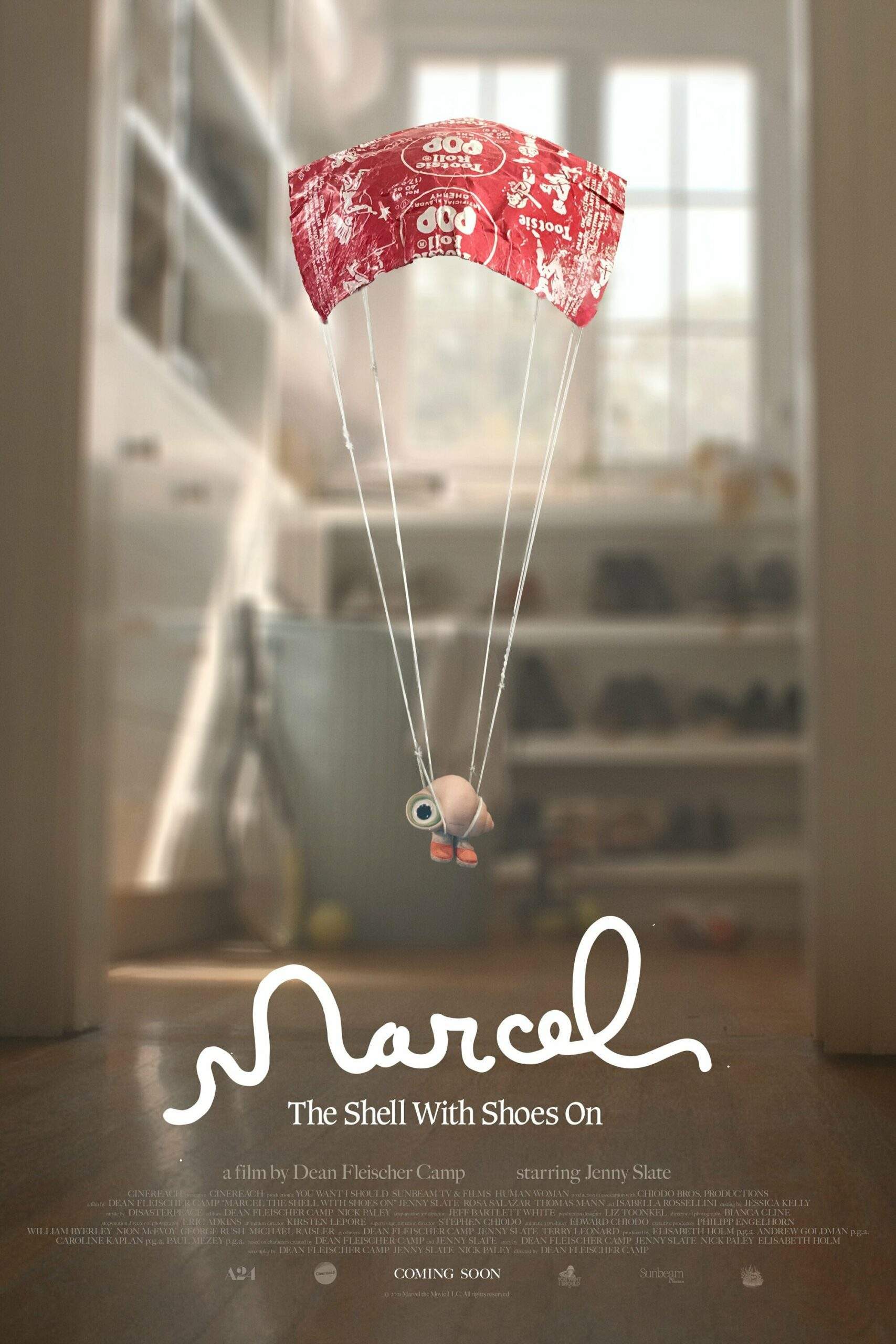
Marcel The Shell With Shoes On
Family Movie Night
PROBLEMATIC TROPES TO UNPACK AS A FAMILY
Welcome to the Family Movie Night Series
Let the battle begin
Marcel The Shell With Shoes On
Screened with R2 (age 8) & Q (age 10)
Watch Marcel The Shell With Shoes On (afflink)
Spoilers Ahead!
Ashia R:
Hey friends! It’s Family Movie Night, and Q has picked Marcel The Shell With Shoes On.
We’re gonna deviate from the norm here. I am not just rambling aimlessly as I watch this movie – it was the kind of thing you really have to watch a handful of times to get a good grip on.
(So I wanted it twice for a loose, sweaty pawing before our 48-rental ran out.)
I’m not even gonna be like “SURPRISE THIS MOVIE WAS GOOD” – let’s just get it right out there. This movie was fantastic.
Q fell so head-over-heels for the claymation and subtle visual effects he watched it a handful of times in a row.
I was into it for the little vignettes of each scene, which felt like a nice calm Sunday nap in a sunbeam.
In fact, I was so obsessed with the pacing and little jokes, I completely missed the plot the first time around and had to re-watch it to actually understand what was happening.
Through this movie, we discussed the following topics as a family:
- Family separation (albeit a very tame, not-that-bad, white American ‘happily-ever-after’ situation)
- Wrestling with the emotional and physical labor of care-giving for an older adult in decline
- Making do and the difficultly of survival when isolated from community and support
- How grief impacts us beyond the standard movie depiction of crying and looking sad
- Fear of change and clinging to safety as a trauma response
- How being a celebrity on the internet actually really sucks in real life
That’s a lot, Right? So good!
First Watch & Also All My Baggage
(skip this if you’re really into Successful Creative White Women Biographies I don’t wanna ruin them for you.)
I’m kind of excited to watch this, because Jenny Slate is weird and hilarious.
I tried to finish her book Little Weirds (afflink) but I have a hard time reading books by rich white women without feeling the urge to crawl under a pile of blankets and just give up.
No hate – Jenny Slate is BRILLIANT and she worked hard to get where she’s at.
Both Slate and I are the same age and grew up less than 10 miles apart. Both of us were deeply odd children.
(although if we were gonna make this a competition between creative little weirdos, I definitely would have won.)
So it’s hard not to read her biography without a sense of parallel-dimension-ness. Slate grew up in the wealthy Boston suburb of Milton, in a fancy house with a loving family who embraced her eccentricities and sent her to private school.
I grew up in the neighboring town of Randolph, which is where Milton dumps their chemicals and stores their housekeepers.
My mom was a hairdresser and all her most affluent (and rude) clients were from Milton. I also went to camp there in my mom’s first attempt to white-flight our way out of Randolph.
I’m sure this was a self-selecting crowd, since at all points of contact we were ‘the help’ or ‘the financial aid kid’ – but I’ve never met anyone – of any age – from Milton who didn’t have the air of an 80’s preppy villain. Wearing sweaters like a cape and carrying tennis rackets around. Talking about ‘the help’ like pests they gotta deal with.
This is all generalizing – but now that I live in a wealthy city that imports brown people from poor towns nearby to provide our services, the stereotype holds up. Rich people are even worse when they think the poors are no longer in the room.
And Jenny Slate’s characters – particularly her caricature-esque spoiled brat character of Mona-Lisa Saperstein from Parks & Rec, really play well off of those rich villain-types I grew up resenting. While being ridiculously self-involved is hilarious to watch sprinkled through seven seasons of Parks & Rec, in novel form it’s just exhausting to my soul.
Which is all irrelevant to the movie – but what I mean to say is Slate’s Little Weirds highlights all the lovely weirdness that a strange child can blossom to be if she just has all the resources available to her.
So it’s just… while I cheer her on and love her work – it’s hard not to think what could have been if like her, I had enrichment classes, and well-paid teachers who understood autism, and a fridge full of food, and clean drinking water, and fully present parents who embraced my eccentricities.
I felt the same way about biographies by Amy Poehler (who I like a lot!) and Amanda Palmer (who I…like a lot less).
Like yeah, you’re smart, you worked hard – aaaand you also had a team of adults to carry you, no barriers due to race, disability, or poverty. The rest of us are working are too. So it doesn’t negate your hard work to acknowledge that privilege plays a role in there?
White women’s biographies are always so fucking self-congratulatory.
Thanks for letting me get that out of my system! Moving on to Marcel.
But oh here we are in her long-running project, ‘Marcel the Shell With Shoes On,’ Slate encompassed in a weird little stop-motion documentary about a shoe-clad shell creature, and this seems like just the perfect medium (and dose) of Jenny Slate’s artistry.
“I have shoes and a face. I like that about myself.”
Yes I like that about you too, Marcel.
He’s impossible not to like!
In this latest Marcel project (Marcel has been a Youtube short, a book, etc.), a nameless filmmaker is making a documentary about a little Shell, and so far it’s feeling very much like the kind of movie your average 10-year-old can make.
(I mean like I know this was well thought out and took a of work – but it’s inspiring the way Pinterest crafts make you think “Oh hey maybe I could do that if I had some free time.” Even though you definitely can’t because the rule of kanketsu applies to everything subtly gorgeous and our human brains are too clumsy to realize it.)
In fact – Q has a series of stop-motion movies featuring a clay creature named ‘Glom Glom’ and most of them kind of capture this energy. So he’s nerding out because the movie is combining stop-motion and regular video, and he’s like “HOW DID THEY GET A VIDEO OF THE CLAY IN MID-AIR?!” (Something he’s struggled over endlessly in his own movie attempts).
Well kiddo, they had a full movie studio worth of fancy equipment and a huge pile of people working on special effects! And probably parents who gave them the scaffolding they needed to thrive. Don’t beat yourself up about it.
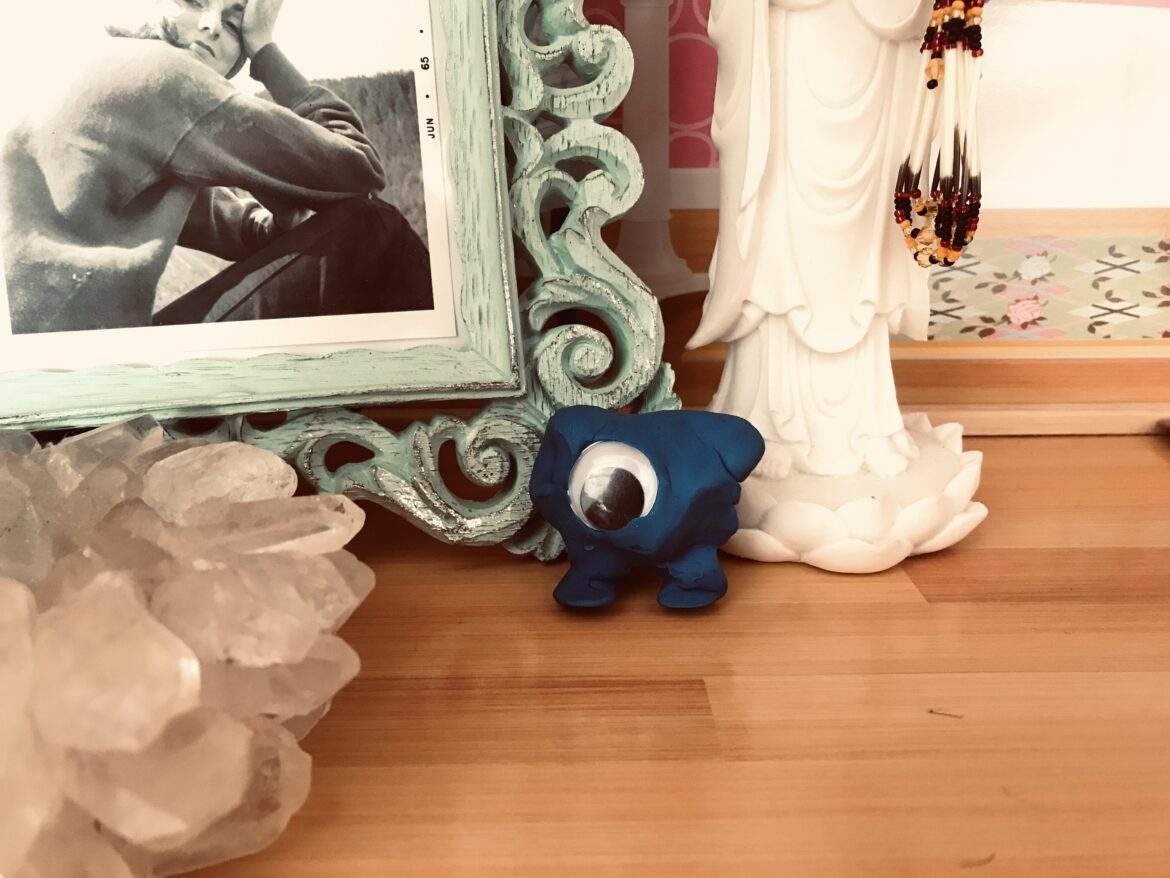
Marcel describes a documentary as a movie where “Nobody has any lines – and nobody even knows what it is when they’re making it.” which is the perfect description for a documentary but also the nice kind of humbling burn that every documentary maker could use to keep it real.
(but also I read up about the making of this movie, since every scene and line was painstaking perfected to feel breezy but pack a punch. Kanketsu.)
I got so caught up in the film work on sunbeams, I missed the entire plot
You know how I get personally offended when the director of photography calls it in. Every single scene and lighting setup though – *chef’s kiss.*
In fact, I was so enamored, I kind of missed the plot the first time around. It felt like watching a non-linear series of beautiful moving vignettes.
Since I was absorbing each scene as a stand-alone series of charming quips, I missed the bigger plot – Marcel and his grandmother are almost years into coping with a devastating crisis where their entire family and wider community were suddenly whisked away during a natural (well, human-made) disaster beyond their control.
Like – the visuals don’t match the horror of what really happened. This is some post-apocalyptic shit!
At some point, Marcel nicely captures that feeling right after someone you love dearly dies. The sunbeams and pleasant weather of the outside world just don’t match the horror of the situation.
He talks about how gorgeous the weather was the day after his entire world was shattered: “If I was somebody else, I would really be enjoying this.”
Fortunately, Marcel isn’t completely alone – he and his grandmother, Connie, have learned to fend for themselves.
Marcel’s grandmother is voiced by Isabella Rossellini. Marcel explains her signature Italian-Swedish-Hollywood accent with “She’s not from here. She’s from the garage.”
Now that they have to feed themselves on their own, they’ve come up with all these ingenious ways to survive, from homesteading in the planter boxes to harvesting ‘Hardy Hairs’ from the bathroom shower to build rope.
Our documentary picks up right when Connie is starting to show the first signs of dementia.
They could have gone sad-sack pity-party with this. They could have painted Connie as a burden for Marcel to care for, in addition to surviving in a post-apocalyptic air-bnb.
But instead, Connie has become Marcel’s everything. She’s his whole life. the relationship between the two is so softly beautiful.
“She has lost a small piece of a very large puzzle”
He acknowledges how it’s challenging to care for Connie on his own – without painting her the nail in the coffin of all the shit he has to deal with each day.
Connie’s memory lapses and support needs are also respectfully portrayed. Unlike movies where folks start downhill and decline fast, Connie is still mostly self-sufficient, still curious, still learning, still insightful and tough. At first, Marcel almost seems like he’s being a worry-wart.
All this, and the movie has barely even started. You see? It’s really the kind of movie you’ve gotta watch many times. It’s been a week and Q has started saving up his allowance to purchase a copy to keep.
Isabella Rossellini Is The Best Shell Grandma Ever
And I’m thinking – wouldn’t it be cool to just do a full marathon of *EVERYTHING* Isabella Rossellini has ever been in?
Like you’d get an excuse to watch Owl House and Death Becomes Her and Los Espookys and the entire Green Porno series.
I mean – it’d be a good use of your time! Right?!
“I don’t want to lose everything in the hope of something – that’s already gone.”
Marcel addresses the delicate balance of being there for his grandmother as she ages – the worries about how she’s becoming more delicate, the compulsion to protect her from the world, the guilt over bringing the outside world into her universe while she’s becoming more fragile.
He goes on to become more afraid of change – explaining how hard they’ve had to work to survive since his family separated – why he’s nervous to keep trying to find his family, to accept help –
“Just had to work so hard just to do THIS. just to find new ways of doing things and learning how to survive on our own. I don’t want to end up with less than what I have.”
Yup. Yup yup yup. How GREAT is this for discussing with the kids – living with trauma is more than just flashbacks and hyper-vigilance. There’s just so much less space for creativity and risk when you’re still recovering from all this terrible shit beyond your control.
Both kids have noticed that Connie doesn’t *always* use her walker, so we’re talking about how many folks who use accessibility devices don’t *always* need them, like how I don’t *always* need my earmuffs and folks who have more and less spoons at any time don’t always need wheelchairs and pain medicine.
The shallow perks and deep despair of going viral
Getting popular on the internet always comes with a big dose of Awful Unexpected Crap – it’s kind of like having a house-party, but your guests invite their own friends you don’t particularly like, and so on, until the whole town is vomiting on your lawn?
Marcel, along with his documentary filmmaker friend, go viral on Youtube in an attempt to find his family. And at first it feels great to be so popular, to have so many eyes on the project you care most about.
“There’s all these people and we’re all looking at the same thing. And we’re all doing the same thing.”
But ultimately the attention this brings is usually carried by terrible people who are just looking to divert attention away from your cause, toward themselves. There’s that shadow of community – but also not actually being together – it’s what you settle for when you don’t have hte resources to host a real connection.
Like when you’re a tiny shell creature with very limited power to search the whole world for your family. Or an over-extended parent managing disabilities and life challenges and need to do something to help the world, but are limited by so many constraints of time, funds, and social skills.
Trying to use viral fame to search for his family – Marcel instead got a bunch of people dancing on his lawn and filling his life with inane bullshit. As he reads the comments, hoping for folks who can provide tips and info on his family – there’s just “so much nothing.”
“I don’t feel like this is the task force I was hoping for.”
After a while, when your stuff goes viral on the internet you gotta dust off your shit-shield and brace yourself for all the asshats derailing and exploiting your content to do the exact opposite of what you had worked so hard to do. For every one person you reach who really connects with your stuff and carries it forward, there’s like three-thousand performative allies mucking up the works.
“It’s still a group of people. But it’s an audience. It’s not a community”
To be an audience, all you have to do is passively consume. But to be in a community, you have to actively engage, and put in effort, and risk putting something into the group that might not turn out the way you hope.
It takes courage to be in a community. And reciprocity. And risk.
Everyone wants to participate, to be seen as part of something bigger. But few folks are willing to contribute
Partially because passive consumption – especially on the internet, just drains us all of our fucks until we feel we have nothing of actual value left to give.
::cough cough:: we cover this the Summer Accelerator COME JOIN US :: cough::
Sneak peek of Chapter 2, Caper 3: Why Can’t We Be Heroes? Click here for the transcript.
Anyway, this is just a long ramble to say, we enjoyed this movie. It went a little slow (and over the head) of the 8-year-old, but the 10-year-old was so enamored he spent a full week roaming around the house, building clay shell creatures, and lamenting “Why didn’t you TELL me there were movies this good BEFORE?!” – looks like were officially in THE TWEEN YEARS.
(“No human in the history of time has ever felt feelings SO DEEP and ANGSTY!” – My kid at 10. Me at 10. Every human in the world at 10.)
Umm, dude, until now you were not cognitively able to enjoy much beyond cartoons jumping around and falling off of things?
I have no good closing for this. Except to leave you with this goldmine of a compilation and Slate’s brilliant depiction of Mona-Lisa Saperstein:
“There is no way I could be pregnant with a human baby.”
Wow, actually I just watched this all the way through. This character is a lot when you string all her scenes together without respite.
But wow, between Mona-Lisa and Marcel, that range!
ipsum lorem
How we calculate the overall awesomeness score of kids media.
JOIN THE CONVERSATION & SHARE YOUR TAKE
How did you unpack
this movie with your kids?
This page may use affiliate referral links. We may earn a small commission if you choose to make an order using these links.
Learn how we use affiliate links to support our community.
©2014-2026 Ashia Ray of Raising Luminaries™. All rights reserved.
Raising Luminaries is anchored in the land of the Wampanoag & Massachusett People.
Support Wôpanâak early childhood education here.
Photographs via Unsplash & Illustrations via Storyset, used with permission.