Every month we watch & recap a children’s movie with the Earthquakes and unpack the sneaky media tropes that reinforce bigotry, supremacy, and problematic devices.
Family Movie Night Recap
Nimona
Family Movie Night
PROBLEMATIC TROPES TO UNPACK AS A FAMILY
Welcome to the Family Movie Night Series
One step forward for the rainbow mafia. Two steps back for fat kids.
Nimona (2023)
Screened with R2 (age 9) & Q (age 11)
Read Nimona (afflink). Article also contains affiliate links.
Spoilers Ahead!
Content warning for physical violence, child abandonment, violence against children, dismemberment
Ashia R:
Hey friends!
On Alison’s suggestion, we’re watching Nimona.
I’m excited! I enjoyed it back when it was still a web comic, and Q loved the book back when he was first getting into graphic novels.
Between the chunky protagonist and gay mentor, it was pretty revolutionary representation back in 2015.
As we launch into the movie, it looks like they’re leaning in. The Queen is Black, as are the newscasters introducing the story.
But they’re also changing up the movie from the book significantly (which might be fine!) While the original comic focused on the relationship between Ballister and Nimona, fleshing out their backstories in flashbacks as the story progressed, we’re starting out with Ballister’s backstory as a ‘commoner’ who becomes a knight.
It might turn out fine! But we’re like 6 minutes in, and already I’m a little bored.
Instead of a mischievous scamp and a curmudgeonly supervillain, we’re starting with the story of an underdog class migrant framed for regicide before Nimona even shows up.
Back to the story! Nimona is here!
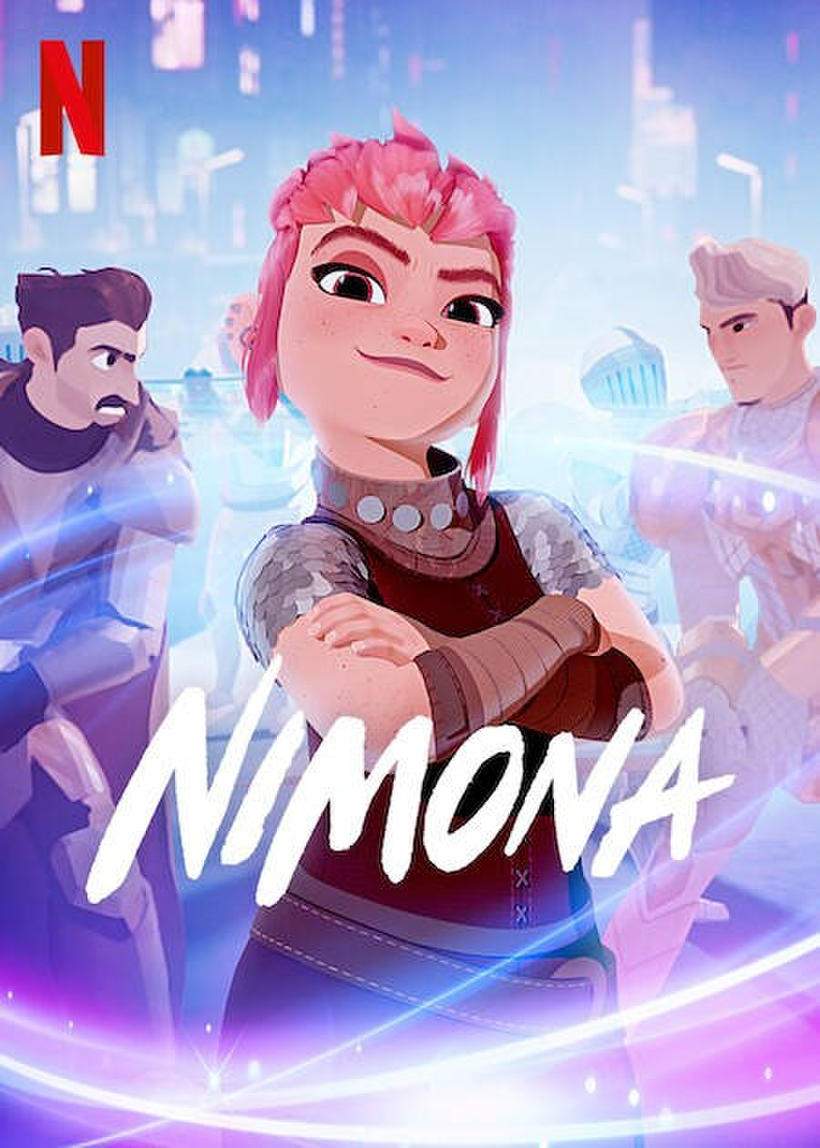
And she’s… significantly thinner and taller. What the FUCK.
Seriously. What the fuck!
The original Nimona was bottom-heavy, fleshy, with thick thighs and arms. She looked like a (cartoon version of) a real 20-something. She was short and squat and one of the few chubbier representations we actually had on our side.
Most importantly – she was a shapeshifter. Like Madam Mim, Nimona could have used anything for her everyday look, but she chose this body.
But in this movie, they cut at least 40 pounds off her and reduced the only ‘thick’ part of her to just the hips and ass – one of the few places women are allowed to carry weight, according to the post-Kardashian apocalypse hellscape we live in now. I’m at my heaviest weight since before the pandemic – and I’m still thinner than this skinny-armed movie version.
This seems to be an effort to make Nimona look younger, more teen-ish, so it could appeal to a younger audience.
But uhh… I guess they forgot that teenagers can also be fat?
Feels unnecessary, since the original story, hijinks, and the complex friendship between Ballister and Nimona was perfectly engaging for my 8-year-old. SOMEHOW, my kiddo had no problem following a story between a chunky 20-something and a surly middle aged man just fine.
So this feels insulting. Insulting for kids. Insulting for short dumpies like me, and generally insulting for the comic’s original fans, and the new ‘target’ audience who don’t need to be catered to like this.
:::trying to get over this betrayal:::
Onward with the (drastically different) story. Nimona just kind of bounds in and they’re fast friends, compared to the book.
Sometimes you gonna speed up the plot and leave stuff out in the transition to a movie, but they added a ton of actiony-fluff, and left out the charming bits that show Ballister’s personality.
In fact – this Ballister is a completely different guy. In addition to being at least 20 years younger, he’s less moody, he’s more… basic.
All this bouncing around in the city, we see a good deal of regular citizens. Many of whom are chunky! So the illustrators can draw chunky people. They understand the need for fat representation. But by relegating the chubbies to the background, it just underlines how much more drastically thin Nimona is compared to the ‘regular’ people.
—
Okay – let’s move on to LGBTQ+ representation. Because basically everyone in this movie is queer.
Like in the book, Ballister is gay. Stevenson wrote Nimona before he knew he was trans. Nimona’s shapeshifting has been celebrated by the gender creative community since the webcomic. Nimona herself happily swaps between she/they pronouns and comfortably changes gender as her whims take her, reminding Ballister repeatedly that she’s not a girl.
In the casting, we’ve got a full rainbow mafia of gay men, drag queens, although I’m not sure if there are any lesbians (probably? But all the actors on the cast I recognize are dudes).
Actually – this movie is pretty dude-heavy overall. Our villain is a dude, Nimona leans feminine, and there’s that dead Queen and a long-dead knight called Gloreth. The animators admit that feminine bodies take up at least half hte population, especially in the background.
But it’s a story written and produced by a dude, so it’s not surprising to have few women and zero lesbian representation or women with speaking parts in these sorts of things. ::: sigh :::
Oh maybe I spoke too soon? Nimona’s having a childhood flashback to making friends with (what appears to be) a little girl. But – oh no! This girl turns on her with a quickness once the other folks get creeped out by her shapeshifting.
Ooooh – and that little girl grows up to be the knight Gloreth, reducing our women with speaking parts back to before.
—
And what about disability representation?
Unlike the book, which leans heavily into the Evil Crip trope, the movie makes some improvements.
Both in the book and movie, Ballister Blackheart/Boldhear has a a limb difference.
In the book version, Blackheart is super bitter about it. In the movie version, Boldheart’s disability a part of his ‘villain’ origin story, but the movie makes it clear that Ballister isn’t actually a villain, but more of an anti-hero against the corrupt government.
So while he initially appears to fall into the Evil Crip trope, the story swings it back around in a way I really like.
In the book, we get a SURPRISE! scene where a person turns out evil, and this is visually defined by the SURPRISE that they have alopecia. Stevenson even goes so far as to insult the bald character, questioning if (this very human person) is a ‘goblin.’ It was gross when Stevenson wrote it, it’s still gross. Which is probably why the movie version doesn’t pull that bullshit.
That said – did anyone else catch another disabled person in the story? Even in the background? I was busy writing this and didn’t keep a keen eye out, but I’m pretty sure if they had made an attempt at postive disability representation, I would have seen something.
Notice how ‘revolutionary’, seemingly ‘forward’-thinking’ movies like this, for all the striving for LGBTQiA2S+, increasing casting of color, centering ‘strong’ [white] plucky feminine characters – it’s is still regressive when it comes to intersectional representation, particularly those of fat, disabled, and older characters.
Stevenson is a regular in the Lumberjanes series. Notice the treatment and erasure of older folks, fatter folks (who fluctuate wildly in size but are only mildly chubby at their heaviest), and older women.
Okay, welp – the kids enjoyed it. And honestly – if I wasn’t comparing it to the book, if I wasn’t so familiar with Stevenson’s supposedly ‘progressive’ brand, I would have enjoyed it more.
It’s kinda like Barbie, with a thin, pretty, smart, ‘strong’ feminine center, surrounded by gay brown men and token fat/brown women dotted around in the background.
It’s very white feminism.
So it’s… fine. It’s enjoyable and good, if you don’t think too hard about it! (But could have been better.)
How we calculate the overall awesomeness score of kids media.
JOIN THE CONVERSATION & SHARE YOUR TAKE
How did you unpack
this movie with your kids?
This page may use affiliate referral links. We may earn a small commission if you choose to make an order using these links.
Learn how we use affiliate links to support our community.
©2014-2026 Ashia Ray of Raising Luminaries™. All rights reserved.
Raising Luminaries is anchored in the land of the Wampanoag & Massachusett People.
Support Wôpanâak early childhood education here.
Photographs via Unsplash & Illustrations via Storyset, used with permission.