Every month we watch & recap a children’s movie with the Earthquakes and unpack the sneaky media tropes that reinforce bigotry, supremacy, and problematic devices.
Family Movie Night Recap
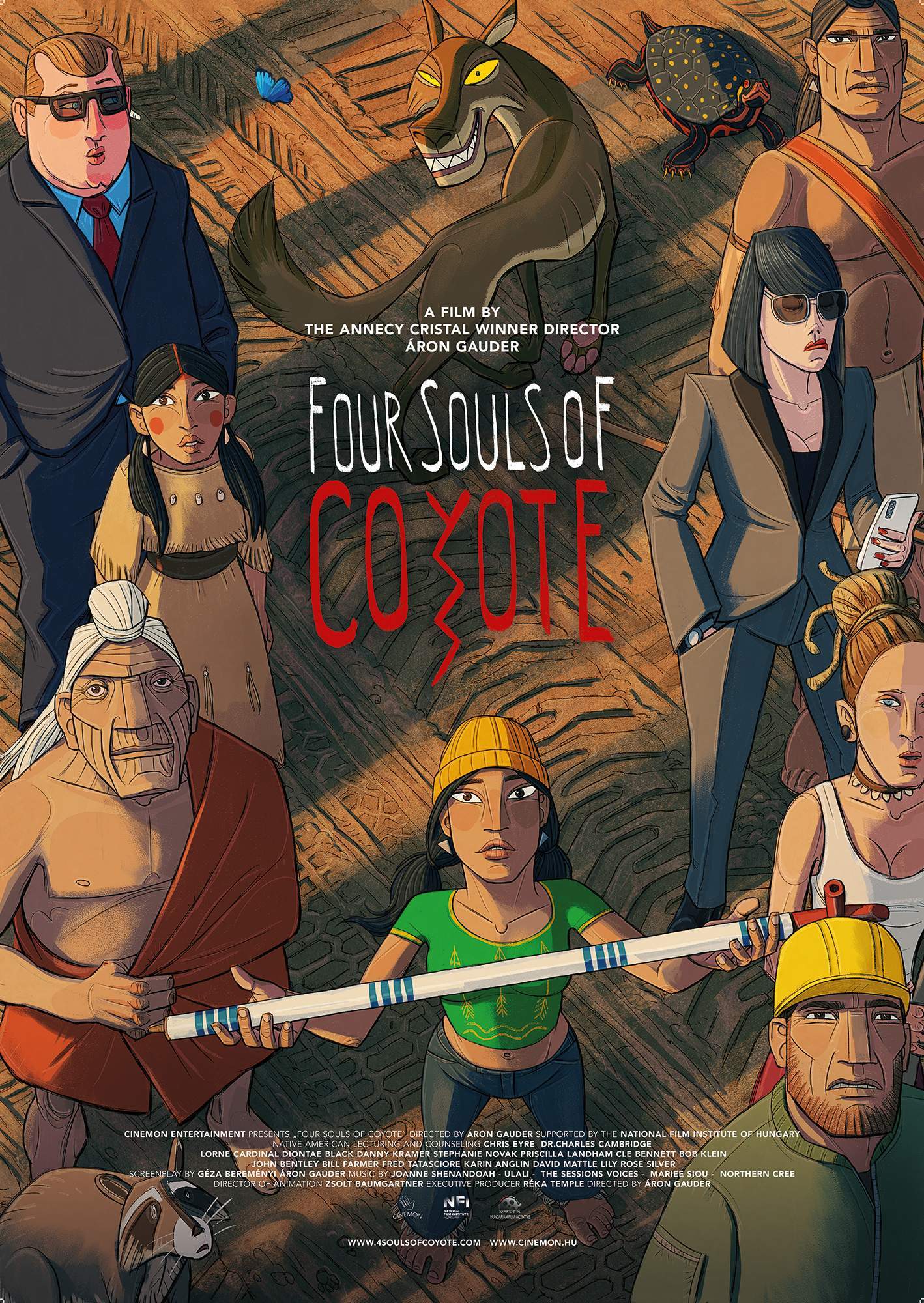
Four Souls of Coyote
Family Movie Night
PROBLEMATIC TROPES TO UNPACK AS A FAMILY
Welcome to the Family Movie Night Series
KEEP AMERICA BEAUTIFUL COMMERCIAL - REMASTERED
Four Souls of Coyote (2023)
Screened with R2 (age 10) & Q (age 12)
Watch Four Souls of Coyote (afflink)
Spoilers Ahead!
Content warning for violence against animals, threatened sexual assault, and :::clutches pears::: a little cartoon baby penis
It’s Indigenous Day of Mourning 2024, and we’re back to picking through the slim choices of Indigenous stories for kids.
The preview for ‘Four Souls of Coyote’ looks promising. It’s an animated film that tackles Indigenous creation stories and environmental destruction. Tying an original Coyote story together with present-day Indigenous-led protests against oil pipelines? And animating it for kids? YES, PLEASE.
I’m trying not to get my hopes up, but you know they are up. Yours are, too. ADMIT IT!
These opening credits feature some very… European-sounding names. I am confused, but that’s okay. We shall investigate this later.
(Note from later: Nothing says ‘authentic Indigenous storytelling’ quite like a Hungarian (?!?) production team. Buckle up.)
And, umm… my TV warned me this film is rated 18+, which is alarming. Not even 17+? Have I made a terrible decision? Am I about to traumatize my ten-year-old?
Maybe. Nevertheless, in the name of critical media literacy, we forge ahead!
The Setup:
The movie starts with the well-known prophecy, “When the last tree is cut down, the last fish eaten, and the last stream poisoned, you will realize that you cannot eat money.”
After a quick search, I find this is commonly attributed to the Cree, though tracking an exact source is tricky. Regardless, it sets the stage for a tale about human greed, colonialism, and our relationship with the land. Also, now I have ‘The Seed’ stuck in my head for the entire duration of this movie.
(More notes from later: Aaaand that song stuck around for a good 3 months after that. Thanks, echolalia!)
We open with a group of oil pipeline workers ready to tear up the earth —some gruff, some sympathetic. Followed up with a pair of snobby executives who are cartoonishly awful, so we know who to boo for.
Enter our protagonist, a young woman driving her grandfather (who, based on his vibes, is about to drop some wisdom) to a small gathering.
Grandpa, as expected, starts telling stories.
Oh, good. An old-story-within-a-new-story framework. I don’t know why every children’s movie/book has to have this tired old framework when an old story is involved. Surely, we can develop a more creative way to link the past and the future, particularly to represent a people who have already established frameworks for circular time. But fine. We’re already invested, so let’s just move on.
(From later on, nope, not the protagonist. Story-within-a-story strikes again!)
Coyote Makes Oopsies
As we get into the action, Grandfather’s retelling weaves together various Indigenous creation stories, most notably the creation of Turtle Island story, in which animals help form the earth.
Only after the ‘Big Brother’ creator finishes making the animals and such, does he take a little nap and accidentally dream up Coyote—our chaotic trickster.
In his infinite mischief, Coyote steals some clay and creates humans. He originally creates them to fatten up and feast on but doesn’t think too hard about it and gives them his hunger, greed, and inability to make good choices. Whoops.
The first humans are a ‘defective first draft’ – I hate this.
But I also have to accept that this is authentic to many creation stories across the world where humans are made from clay (usually an Adam & Eve pair), including those I’ve read from China and Africa. In many of these stories, the ‘defective first draft’ humans are disabled. In others, the defects are women.
In Coyote’s version, the defects are white. Which is hilarious, but also, COME ON. Can we not? If we’re truly embracing decolonization, can we NOT just flip who the ‘inferior’ people are and resist the supremacist compulsion to make some humans superior and some inferior?
(Note from later: this movie was not, apparently, making any attempt to embrace decolonization.)
Coyote eventually shapes two cute roly-poly human babies out of clay. The male even has an adorable little dingle, which the movie is not ashamed to show. That explains the 18+ rating. American kids can watch gore and violence, but heaven forbid we expose a 15-year-old to a cartoon dingle!
Meanwhile, the ‘defects’ get bleached white, slink into the ocean, and crawl up the cliffs of Eurasia to invent European society. Asian folks, African folks, and the rest of us got created some other way, I guess.
I’m not in love with this. Maybe it’s based on an Indigenous creation story, but I none have never heard of. This feels very… white. Hungarian? I don’t know anything about Hungarian culture, but I apparently had higher expectations of Hungarian filmmakers.
Big Brother gets pissed.
Big Brother discovers that Coyote has been creating these nasty little creatures, so he tells Coyote that it’s now Coyote’s job to look after these little monsters.
Which goes about as well as you’d expect. Coyote immediately loses his new children in the woods. Later, Coyote clubs a bunch of ducks to death, invents murder, and teaches his kids to thirst for blood. This might explain the 18+ viewer rating, but it’s more nature-documentary-esque than Deadpool-esque. I’m still convinced the 18+ warning is because of the dingle.
Let’s get Pan-Indigenous For Inexplicable Reasons.
It’s beyond me how someone can create a gorgeous movie with this level of depth about Indigenous creation stories and such a chill vibe without learning, at some point, that mooshing a bunch of Indigenous symbology together to create a pan-Indigenous mishmash is culturally disrespectful.
Like, it’s one of those ‘Things You Must Stop’ on the decolonizing ally bingo card. Name the nations you’re talking about. Name the culture. Don’t squish them together and generalize – that’s how stereotypes and othering start!
Also, depicting pan-Indigenous representation is one of the things that makes cultural genocide so easy. It’s an active erasure of Indigenous people and their cultures. So this a glaringly common red flag – despite wearing the symbolism and aesthetics of an Indigenous-led film, this book is not #OwnVoices.
Okay, now that I’ve had a chance to check—yep, it’s all Hungarians (?!) While the film consulted a ‘Navajo cultural advisor,’ it doesn’t feel only Diné. It’s smelling more like that pan-Indigenous European fetish of the cowboys and indians mythos, modernized for Millennials and Gen Z.
So… exactly like The Seed.
Wrestling with Tricksterism.
The trickster’s journey—Coyote messing up, learning, dying, and coming back wiser—is fine. Unlike American movies, which try to turn characters like Coyote into a hero, villain, or Cheshire-Cat comic relief, Coyote feels like a true trickster. He’s not the smartest, the most skilled, or the most brutal. He’s not an underdog, nor is he particularly likable or charming. He makes mistakes – some inconsiderate, others vile.
R2 (age 10) identifies with Coyote’s struggle and feels like the ‘Big Brother’ authority figure is too harsh on Coyote. Which led to a great discussion about how trickster figures reflect our own mistakes and growth.
That said – there is, of course, a redemption arc for Coyote. Because, like we’ve discovered – this is fundamentally a story written by white people, for a white audience.
Humans Aren’t Nature?
In various original stories, Coyote does create humans, so I can’t knock the basic story this movie riffs on.
But this movie really focuses on the idea that humans are not animals—we are set apart. In the movie, we are either much stronger or much weaker than other animals, depending on what kind of drama they want to stir up in the plot.
At one point, the movie nods to the idea that humans exist in relationship with the animals we are indigenous with, both as an integral part of the ecosystem and beholden to our animal kin. However, the overarching story is that humans are the other, something set apart that disrupts the peace and proper system of the animals. This idea of humans besmirching nature’s purity is a colonizer’s narrative – positioning humans as masters, destroyers, or even benevolent stewards of the land and the animals on it.
Rather than a decolonized approach (as I understand it) – that humans are a part of the ecosystem who really need to get back into our lane.
The idea of humans as a colonizer/master/destroyer promotes the idea that humans must own and control a dominion, so we might as well have a system of land ownership and exploitation is almost a foregone conclusion. Humans be human-ing, amirite?
But if we accept that we have an anti-speciesist responsibility and role in the ecosystem that includes living in reciprocity with the plants, nature, water, and soil we live in, that feels very humbling. To know that we have a place – and that egads! – all of this destruction, exploitation, and harm was a choice?!
To accept that means we’d have to be considerate of non-cute animals and make tough decisions. Like which of our plastic doodads and airline flights and hair cream has to go. Uncomfortable!
Colonizing Gender Roles
And now to the most blatantly obvious red flag that this movie is just a fetish flick – the gender roles.
Despite coming to creation at the same exact time as men, out of the same stuff and for the same (admittedly chaotic Coyote-driven purpose), women in this story film are heavily emotional to the point of the inability to function.
First Woman spends her days following First Man around. She spends her entire adult life crying, snitching, getting sexually assaulted, birthing, nursing, and teaching younger women to follow the lead of men.
At all points, she’s helpless, and at least once, she causes active destruction by freaking out and crying (hysterical ladies, the worst!)
We get multiple obligatory scenes of First Woman as a helpless victim meant to be fed, fucked, and fought for – driving First Man’s development as a complicated and, later, wise protagonist.
(Remember when I thought the protagonist of this movie would be a young woman? Hah! Of course not.)
The men—whether First Man, Coyote, Big Brother, or the elder telling the story outside the story—are the characters who drive the action, make decisions, and generally get all the best lines.
Many original stories across Turtle Island hyper-focus on masculine protagonists. But even those who do—for example, Nanabozho—can take male and female forms and hold many gender presentations.
Given that this is a pan-Indigenous story, there was zero attempt to incorporate the many ways gender comes as a constellation, in addition to how women show up as leaders and protagonists in Indigenous cultural stories. And the genders feel very, very European.
Wait – haven’t we seen this movie before?
I thought this story would loop back and give some lip to the Water Protectors fighting pipelines, but it turns out that beyond a poetic scene of a peacenik water protector handing flowers to construction workers, the women in the ‘outside’ story are not given much more agency.
This movie is just a 1-hour and 43-minute version of Iron Eyes Cody crying at pollution. Implying there’s something inherently noble, wise, and, I dare say, other than the mystical Indigenous American fighting an underdog’s battle against polluting corporations.
White folks love to use an Indigenous face to cry about pollution without actually sharing power with Indigenous environmental activists who know how to do something about it.
And 50 years later, it’s just that old ‘Keep America Beautiful’ commercial. But with dingles.
How we calculate the overall awesomeness score of kids media.
JOIN THE CONVERSATION & SHARE YOUR TAKE
Have you talked about this movie with your kids?
This page may use affiliate referral links. We may earn a small commission if you choose to make an order using these links.
Learn how we use affiliate links to support our community.
©2014-2026 Ashia Ray of Raising Luminaries™. All rights reserved.
Raising Luminaries is anchored in the land of the Wampanoag & Massachusett People.
Support Wôpanâak early childhood education here.
Photographs via Unsplash & Illustrations via Storyset, used with permission.