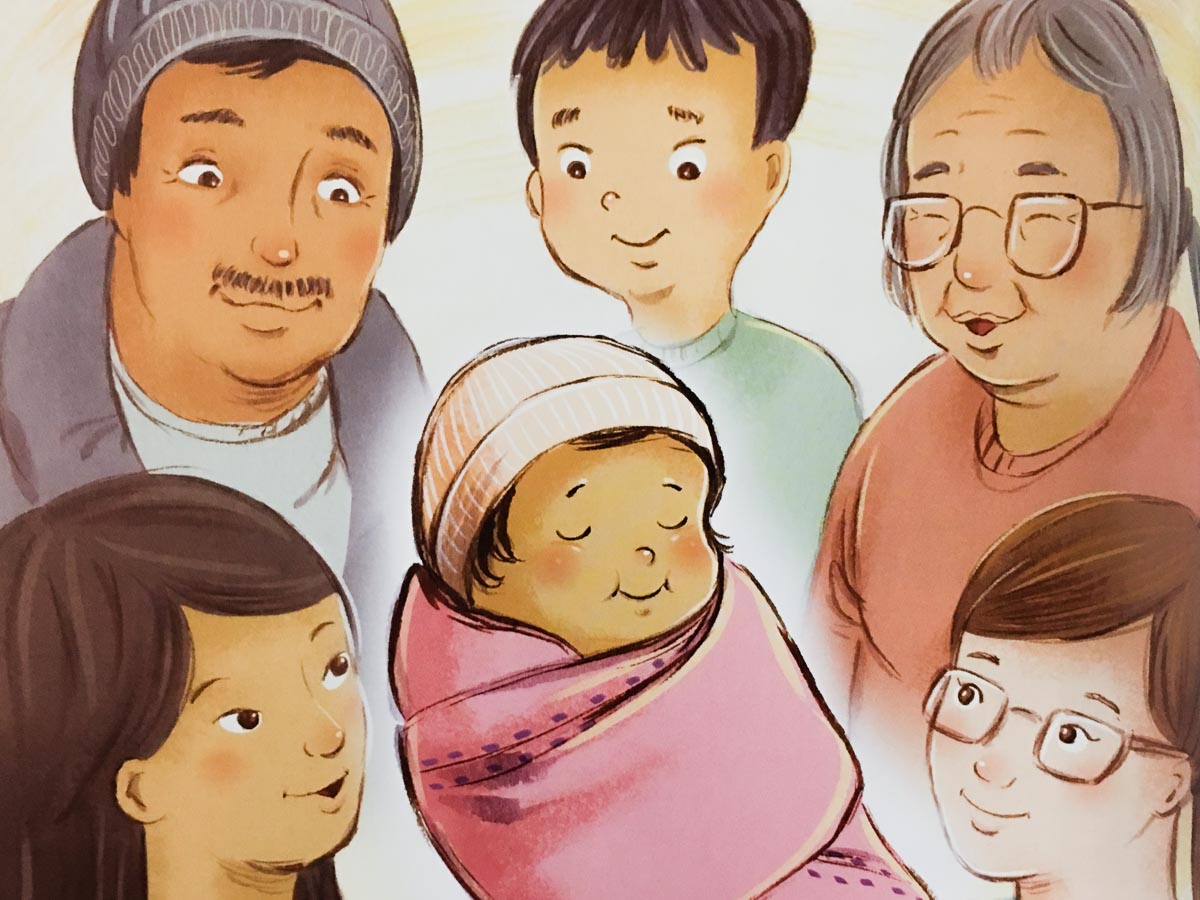
[Feature image: Illustration from ‘How Nivi Got Her Names’ by Laura Deal & Charlene Chua. A swaddled infant floats in the center of the image, surrounded by the faces of five loving family members.]
In this #OwnVoices spotlight: Supporting adopted children requires that parents let go of corrosive and silencing narratives in children’s literature.
Content warning for topics of family separation, emotional abuse, gaslighting, silencing, childhood trauma, addiction, suicide.
Books For Littles is free and accessible for readers who can’t afford a paywall. Posts may contain affiliate links, which allow commissions to support this website at no cost to you.
Dismantling Whitewashing & Saviorism In Adoption Kidlit
#OwnVoices Spotlight: The impact of de-centering adopted people in kidlit
By Liz Latty: Adopted person, writer, activist, adoption consultant and educator
Adoptees are told that losing our family of origin is the best thing that ever happened to us.
The dominant narrative of adoption is one of unquestionable good, a one-time event, and win-win for everyone involved.
Rarely do we even acknowledge the losses adoptees and their first families suffer. If they are acknowledged, they are thought of as a thing that happened to us once in the past, instead of something we carry across our entire lifetime.
Our losses are erased and delegitimized. Because of this, adoptees rarely have anywhere to process grief.
There is no space to be angry, to feel safe or validated, to belong, to be held in the wide range of emotions and experiences we often have. This compounds the initial trauma of separation, informing our over-representation in mental health settings, struggles with substance use, and our disproportionate rates of suicide.
Part of the trauma of being adopted is the experience of being collectively gaslit by the majority of society.
Growing up, I was told that other adopted kids didn’t feel the way I did – sad, angry, depressed, anxious, disconnected, grieving, alone – and it turns out that was a lie. A lie told to me by people who needed it to be true – parents, teachers, doctors, neighbors, and the media.
Adoptees are socialized to be grateful and swallow their pain.
We can all work to counter that trauma by believing adoptees and centering their voices in conversations about adoption.
Validating books for children with no memory of their family of origin
Adoptees – you get to feel however you feel about being adopted.
I want other adoptees to know, if they don’t already, that they are the experts on being adopted – not adoptive parents, not psychologists or social workers.
Adoptive parents don’t know what it feels like to be adopted, unless they are adopted. Most adoptees do not share their true feelings about adoption with their adoptive parents. And even in families where those conversations are happening, parents still aren’t the experts on their child’s experience of adoption.
Most of us never express how we truly feel until we get to talk to other adopted people.
There is an astronomical dearth of children’s books that reflect the reality of being adopted.
The vast majority of children’s books about adoption are written by adoptive parents. Adoptive parents and professionals have the most power and privilege in the child welfare industrial complex (which includes the adoption industry). They dominate the adoption narrative and political landscape of adoption.
We must commit to centering the voices and experiences of adopted and fostered people and their families of origin.
#OwnVoices Stories Written By Adopted People
Hey, Kiddo (kinship adoption in a White family, addiction)
Sixties Scoop (emotional impact of forced displacement and cultural genocide of Indigenous children via adoption)
Ages 12+Ages 4-8Ages 9+
*FTC disclosure: The publisher sent me a free copy of Key Kiddo for the purposes of review. After reading it, I passed it on to an adopted teen. – Ashia R.
There are better ways to take care of families and children, and it is our duty to imagine those into being.
Our adoption stories live in a larger historical and political context. They don’t happen in a vacuum. There can be healing and empowerment that comes along with understanding our own stories as part of larger systems and institutions.
When I say adoption, I’m not talking about kinship care and communal forms of care for children who legitimately cannot safely be raised by their families of origin due to violence, death, etc. I’m talking about the child welfare industrial complex that separates, commodifies, and transfers the children of vulnerable people to the care of wealthier, whiter people who pay to find available children with which to build their own families or satisfy their white savior complex.
I am not here for the reductive, sugar-coated, idealized versions of what people think adoption is.
I understand the industry, system, and institution of adoption as a microcosm of racial, economic, and reproductive oppression, of human and child rights violations, of settler colonialism, U.S. militarism, imperialism, neoliberalism, and white supremacy.
I am unapologetic in my political commitment to the abolition of the child welfare industrial complex, including adoption as we know it.
There are better ways to take care of families and children, and it is our duty to usher those into being. It is possible to simultaneously do the work of reducing harm and caring for the children and families who are currently impacted by these systems, while working toward a different future.
If you are already parenting kids who you love more than anything – How do you sit with the fact that you are complicit in what they have lost? In their trauma? In their grief?
How do you wrestle with that? Even if you can, then what? These are tough questions. Confronting our own complicity is the hardest thing for us to do, but this work needs to be done.
We’re asking parents to apply the lens of social justice, liberation, and trauma-informed healing to the child welfare industrial complex.
Most parents stop short of being able to understand their own complicity.
Parents who do, can begin work to repair that harm, and use their privilege to help prevent separation from happening to more children and families unnecessarily.
Books for siblings that center adoptees
Throwing this category in here because almost all books about adoption tend to center non-adopted siblings. These are the only two books narrated by siblings that don’t do that.
The dominant narrative of adoption is deeply held and beloved. People don’t want to hear that adoptees’ experiences of adoption are different than what they need it to be.
Adoptees who offer complex experiences and critical analysis of adoption are often vilified, dismissed, threatened, erased, and pathologized.
Adoptees deserve to feel seen, heard, validated, and get the kind of care they need.
Validating Books For Kinship Adoption & Inter-Community Families
Your kid won’t get a break from racism, so neither do you.
If you are a white parent of a child of color, understand you will not be able to protect your child from racism.
Be prepared to actively understand and resist white supremacy every single day within yourself, your home, your family, your neighborhood, and the world at large. Be prepared to confront and dismantle your own white saviorhood, racism, and biases. Every single day. No exceptions. Your kid won’t get a break from racism, so neither do you.
Take accountability for your actions and repair harm when you cause it. Get educated, get support, get active.
The United States is a violently racist and xenophobic country. If you think it doesn’t live in your liberal enclave, you’re wrong.
Validating books for kids in foster care & new placements
My New Mom & Me (recently displaced but permanent placement)
Find other adoptees online, reach out, attend an adoption conference or support group, or join some adoptee Facebook groups and just lurk if you don’t feel able to share. The simple act of seeing other people put words to some of the feelings you might have can be incredibly healing and life-affirming.
To smash the kyriarchy without falling into saviorhood, we have to occasionally sit down, shut up, and listen to people with lived experience – even when it makes us uncomfortable.
This is the first in the #OwnVoices Guest Post series, where we’ll boost the message of someone with lived experience in a book collection where I’d be way out of my lane.
As a non-adopted person, I welcome you to add your insight as an adopted person in the comments if/when I make mistakes in our book collections. Disclosure: Liz Latty is a previous supporter Books For Littles (she’s hired me as a kidlit consultant). Check out the full Books For Littles statement of accountability.
(she/they)
Liz Latty is an adopted person with over 15 years of experience in education, social services, and adoption activism.
She offers one-on-one adoption education with a trauma-informed, social justice framework for individuals, families, and professionals. Liz is currently in the process of launching an online education platform, which will offer webinars and online courses tackling a range of adoption-related issues.
To get notifications, sign up for email updates at www.liz-latty.com and follow @LizLatty on Twitter.