Tackling tricky social justice topics with kids
Different Identities, Different Work: #FamilyManifesto4BlackLives
6.4K
Discuss with your kids:
Discuss with your kids: Acknowledging our power
Every-day questions for non-Black kids families anti-Black racism:
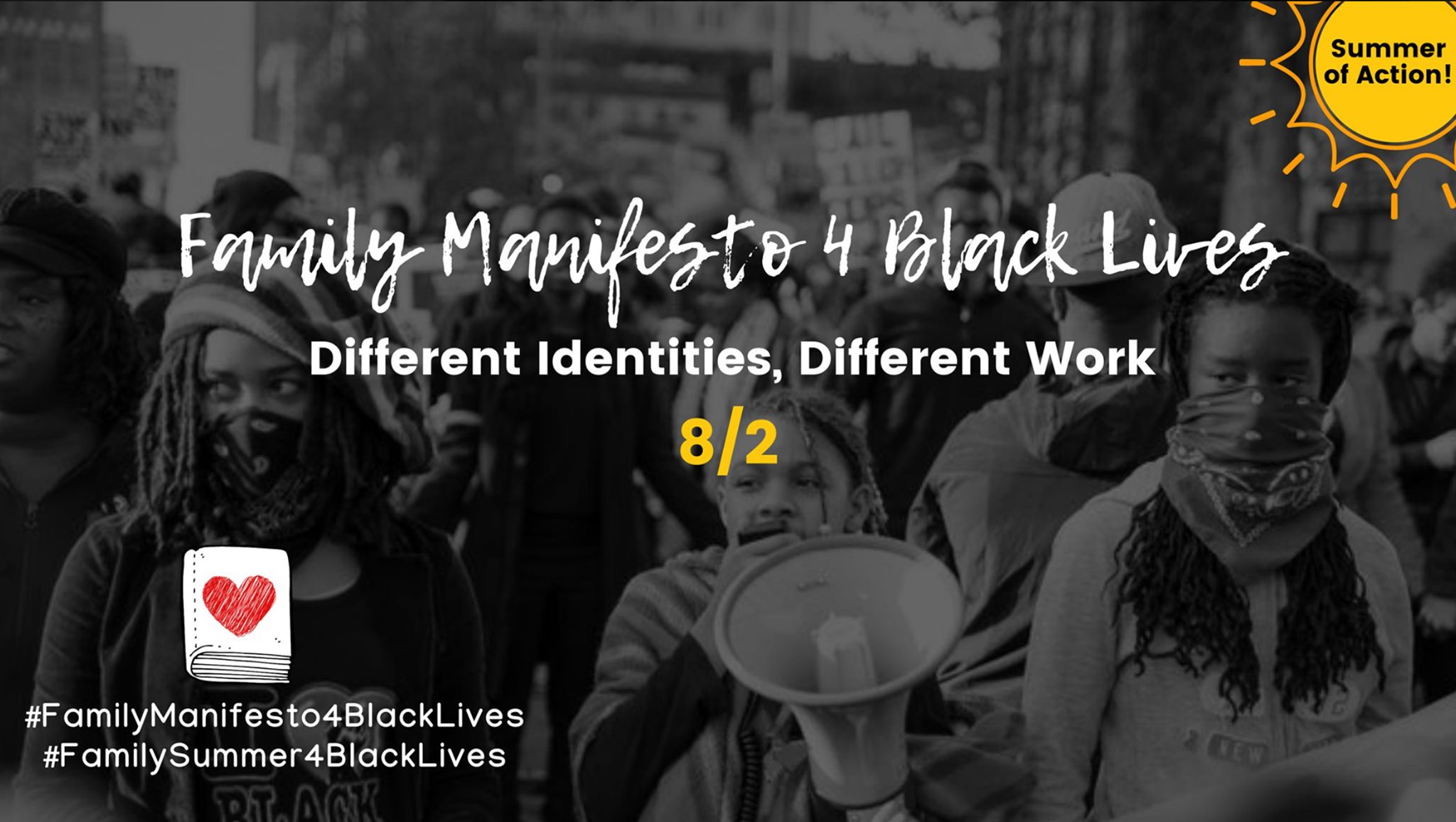
[Image description: Grayscale photo of three children I perceive to be Black & feminine leading a crowd of protestors. Two wear handkerchiefs over their faces to prevent the spread of Covid 19. The youngest child speaks into a bullhorn. Text reads “Family Manifesto 4 Black Lives / Different Identities, Different Work.” A graphic of an envelope with a heart scribbled over it sits on top of the hashtags #FamilySummer4BlackLives & #FamilyManifesto4BlackLives. On the top right, we see the yellow and orange sun logo of the ‘Summer Of Action!’ initiative. Image provided by Revolutionary Humans by Bellamy Shoffner.]
Anti-Racism For Beginners 203
Different Identities, Different Work
#FamilyManifesto4BlackLives
You can create an anti-racist family manifesto in 15 minutes! And it would be spectacular! In fact – our partner-in-cahoots, Revolutionary Humans has a quick & easy manifesto cut-out kit you can print & enjoy with your family!
Unfortunately our family can’t process stuff that quickly. So for those who need to think slow and dig deep, this series of kid-friendly actions is designed to take less than 20-minutes per day. Or if you have kids who can focus for long stretches at a time, an intensive 2-4 hour chunk all in one go.
Coordinated in partnership with Wee The People, Revolutionary Humans, The Philly Children’s Movement, MassArt’s Center For Art And Community Partnerships, and Raising Luminaries.
Day 1: Look Inward
In anti-racism work, we tend to look outward about what we can do, about who is affected – and often forget to look inward.
Discuss with your kids:
Note for kids with communication challenges – if kids are overwhelmed with processing inner thoughts into outward language, use declarative language, and let them know they are welcome to add their reflections when they are ready to talk.
Which could be days, weeks, or never. We’re aiming to have kids process these thoughts internally, not to have them come up with perfect answers.
- What are the current events and stories we’ve heard this summer about anti-Black racism and white supremacy?
- Declarative alternative: “This summer, I learned that there are white people who didn’t know about how anti-Black our police system is. I’m curious about the new things you learned about how white supremacy works in our country.”
- How have these stories made us feel?
- Alt: “When I learned about George Floyd’s death, I felt sad, and angry, frustrated – and helpless. After I saw that more people cared, I still felt sad and angry, but I started to feel hopeful. I wonder how you felt while we were working through this together.”
- What actions have we taken to advocate for Black liberation? Why?
- Alt: “I know you are hurting for the kids in Minneapolis and wanted to send them some love with your painting. Donating your birthday money to Juxtaposition Arts gave more kids in Minneapolis the ability to get their feelings out into art just like you did. I wonder how the other actions we took this summer might have helped.“
- What challenges have we hit along the way? How did we overcome them?
- Alt: “Our mayor brushed us off when we wrote in a letter asking to defund the police because our group has so many young people in it. That’s ageist, and tells young people in our city their voices don’t count so they shouldn’t bother. I’m going to write a letter and talk to the people we know in city hall about how harmful and bigoted that is.”
Day 2: Why different identities require different work in fighting anti-Black racism
Today, we’re going to give kids another simple art project. But first, grown-ups, let’s cover some basics before we dive deeper into this conversation.
White supremacy is a system.
So even though white folks created white supremacy, our entire community maintains it. As targets of anti-Blackness, we’ve placed the onus of dismantling racism on Black people to solve. Does that sound fair? Does that even make any damn sense?
White supremacy is a white person’s problem.
As the primary beneficiaries of white supremacy, as the recipients of power, as the folks with the least barriers in the way – it’s a white person’s responsibility to end it.
Why should white folks end it? Many white folks have told me they’re fighting white supremacy to help people of color. NO! We don’t need saviors. Do it for white folks. White supremacy is a lie that separates European descendants from the rest of humanity. It’s a lie that says white folks have to exploit people of color to survive.
Supremacy divides us, and being separated and disconnected from each other hurts. In dismantling white supremacy, we’re not trying to drag white folks down (as if we all live on an imaginary staircase, which is a terrible place to live) – we’re trying to come back home, to find each other. White folks – fight white supremacy in service to your own liberation.
Non-Black people of color – anti-Blackness is also our problem
We benefit from anti-Blackness. We leverage colorism & racism against Black folks to paddle our way toward the bait of white acceptance. We are targets of white supremacy, and white supremacy stands on the footing of anti-Blackness. Shoving Black people down to gain a foothold just strengthens white supremacy!
White supremacy divides people of color to weaken us. Supremacy tears us from our white friends, our Black friends, and even our fellow people of color. It rips us from the people we love, without our consent.
The only way to heal our family is to acknowledge our complicity in anti-Blackness, and take action to unite as one people who want to be free – together.
The only way to end racial subordination is to end white supremacy.
The central pillar of white supremacy is this made-up identity of whiteness. Folks who were rich, powerful, and greedy to stay that way created the definition of whiteness. They drove power to whiteness, decided who had access a white identity, and chose who to use as fuel in elevating white power. And then they sold marginalized white folks and non-Black people of color lie that we could earn our way to equal power if we behaved, worked hard, and examined Blackness as the root of racism.
It’s on non-Black folks to stop victim blaming, to stop trying to win a racial competition we didn’t ask to join. It’s on us to examine whiteness as the root of racism.
White people have a very, very serious problem… and they should start thinking about what they can do about it.
Dismantle whiteness – together – but in different ways
We live in an imperfect world – where all of us have different barriers and access to power due to our racial identities. That means we all must take on different responsibilities.
In the following days, we’re going to help our kids understand:
Who are we? What power do we have? How can we leverage that power to dismantle whiteness?
As an Asian person, it’s outside my lane to suggest actions for Black families. So let’s amplify our Black-founded coalition partners Revolutionary Humans & Wee The People as they curate affirmations, opportunities to rest, resist, learn, take action, and affirm the identity of Black children amidst the constant weight of surviving in an anti-Black society.
Meanwhile – us non-Black folks should be using the tools at our disposal to end anti-Blackness.
Discuss with your kids:
While the kids do their art-thing, discuss:
- Who created the idea of race? Why?
- Should we fight racism? Why?
- Whose responsibility is it to end anti-Black racism?
- Who should we listen closely to, and whose lead should we follow* in ending anti-Black racism?
*Black anti-racism educators! Center the voices and follow the directions of targeted folks when doing accomplice work. Listen, believe, and honor requests, but don’t just ask your Black friend to guide you – just because they’re Black doesn’t mean they want (or are equipped to) to take on the labor or anti-racism education. As an Asian person – I’m following the lead of Wee The People in our #FamilySummer4BlackLives initiative.
Day 3: We are…
Today – we’re talking with our kids who they are, so in following activities we can identify what resources we have available, and how to use these resources to dismantle racism.
Discuss with your kids:
What is our family’s racial identity?
If you haven’t already started talking with your kids about your family’s racial identity, visit Raising The Resistance‘s Discussion Guide For Families: Race, Ethnicity, Nationality & Indigenaity to understand the identities within your family.
What does our family believe?
Do we believe that Black lives matter? Do we believe that punitive justice targets Black people? Do we believe in defunding the police? Do we believe the school to prison pipeline targets vulnerable kids? Do we believe in abolition?
Name it. Own it.
For more ideas to create your family’s activist identity, check out Revolutionary Humans’ self-affirming cutout set -(and join me in supporting this RH on Patreon so Bellamy can keep creating activist resources for young kids.)
Day 4: We have…
Now that our families are able to affirm who we are, we’re ready to start resourcing – identifying the tools, abilities, and power we have accessible to us in the face of a crisis.
This helps our kids understand why activism isn’t a one-size-fits all check-box of steps. The action we take hinges on what is within our control to mitigate and prevent harm – to ourselves, and to others.
Resourcing requires a pause. It’s taking a moment to regroup and think – particularly when we’re feeling stretched thin and overwhelmed. Like say, when the world is burning, the government is turning into an authoritarian dictatorship, and you’re trying to survive a pandemic.
Discuss with your kids: Acknowledging our power
Get creative with this. It wouldn’t have occurred to me that a library card, an autistic hyperfocus on picture books, and two opinionated children who refuse to suffer mediocre books could be weaponized as tools to fight the kyriarchy, but here we are.
- What material resources do we have?
- Internet access & a computer. Poster board & markers. A car.
- What financial resources do we have?
- Ex: A piggy bank, steady income, allowances, birthday money, a retirement account.
- What interpersonal resources do we have?
- Ex: Close ties to with grandparents, friendly neighbors, mentors, trust and mutual admiration with a friend
- What community resources do we have?
- Ex: Organizations we volunteer or work for, parent-teacher-organizations, faith communities, online parenting groups, virtual playgroups, membership in photography or book club, membership to a local museum, a blog or social media page.
- What public government resources do we have?
- Ex: Within the US, we might have – mayors, city council members, town selectpersons, school committee members, state representatives, senators, governors. Remember, these are elected officials, and we can vote them out if they ignore and dismiss our calls to action.
- What abilities and skills do we each have?
- Ex: My 8-year old is super-human-level loud, and we assigned him to yell at cars to get them to pull over and buy lemonade in support of reuniting families separated and detained at the border. It was surprisingly effective – so work with what you’ve got.
Day 5: We will…
We’ve acknowledged who we are, and we’ve also discovered what we have – the unique resources we have available.
Now it’s time to brainstorm actions – what are you capable of doing with the power you have today?
Kid-friendly action ideas to get you started:
Black families: A manifesto of joy and liberation
- Create an affirmation poem, like in A Place Inside of Me
- Curate an exhibit celebrating my family identity, like in Milo’s Museum
- Create a playlist of joy and liberation, or resistance and survival, like this one by Wee The People
Non-Black Families of color: A manifesto of confronting anti-Blackness within our communities
- Write letters to our family, friends, and community organizations in support of Black Lives, find templates in this Open Letter Project.
- Do our own research to find the ancestors who have fought for Black rights and celebrate them, instead of the ones who used Black people as a footstool for white approval. Talk about both of the ways our ancestors have been complicit in anti-Blackness and in solidarity with civil rights activists in school, and in our communities.
- Examine the ways the model minority myth, settler-colonialism, and xenophobia has been used as a tool to oppress and exploit Black people in the US, and support legislation to correct it. Find easy scripts here via 5 Calls.
White families: A manifesto of disrupting white supremacy
- I can call a friend or family member and have honest discussions about race
- I can rally our school community to teach Black Lives Matter at school
- I can disrupt white-centered spaces and conversations and I speak up when we silence, malign, brush off, denigrate, or exclude Black voices.
Every-day questions for non-Black kids families anti-Black racism:
- What did racism take from us today?
- How did we benefit racist systems today?
- What choices did we make to let racism grow unchecked?
- What choices did we make to disrupt racism?
Day 6: Uphold The Inherent Value & Humanity of Black People
Stay tuned on the Family Summer 4 Black Lives facebook page – we’re currently working on ways to lead non-Black POC & white folks to doing work examining complicity whiteness, while Black families are invited to rest and receive.
Our current plan is to raise funds to purchase copies of Zetta Elliott’s A Place Inside of Me: A poem to heal the heart, and with the direction of Wee The People & Zetta herself, direct it to Black kids navigating trauma, healing, and grief under the weight of living while Black in America.
Day 7: Chalk the Walk: We are… / We have… / We will…
Following the inspiration from Revolutionary Humans’ Family Summer 4 Black Lives templte prompts, go chalk the walk with your family manifesto. Be sure to support her hard work!
- We are…
Pick 1-3 of your results from Day 3
ex: We are Irish & Chinese. We believe that Black Lives Matter. - We have…
Choose three of the resources from Day 4
Ex: We have enough food, clothing, and shelter. We have a library card. We have relationships with our school administration. - We will…
Brainstorm 1-2 actions we can take to weaponize the resources we have in the fight against white supremacy.
Ex: We will donate a percent of our income to a Black-run abolition organizations and activists. We will read about the ways we are complicit in white supremacy, boost #OwnVoices Black authors, and tell our community how to reject normalized white supremacy in media for kids. We will write letters to our representatives, our school committee, and advocate within our school for an #OwnVoices-created anti-racist curriculum.*
Map it in a chart, scrawl it out in text, draw a mural – let your kids fly with your the affirmations and promises of your new family manifesto.
*Note for our literal-minded friends, it might be a good idea to list a frequency or conditions for your action. Activist burnout is real, and folks of color with disabilities are particularly vulnerable to it. Showing up for 2 city council meetings per year, instead of all city council meetings, is much better than burning out and showing up for none
Stay Kind, Stand Brave & Join #FamilySummer4BlackLives
Leave a comment – what action is your family taking this summer?
Follow & collaborate together with our coalition: Wee the People, Revolutionary Humans, MassArt’s Center for Art and Community Partnerships, the Philly Children’s Movement, and Raising Luminaries as we create a 2020 Summer of Action to support anti-racist families in building a better future together.
previous post