Image description: Interior spread from ‘They, She, He, Easy As ABC’ by Maya & Matthew, published by Reflection Press.
In this post: Dismantling cissexism & gender bias for story time – inclusion is as easy as learning the ABC’s
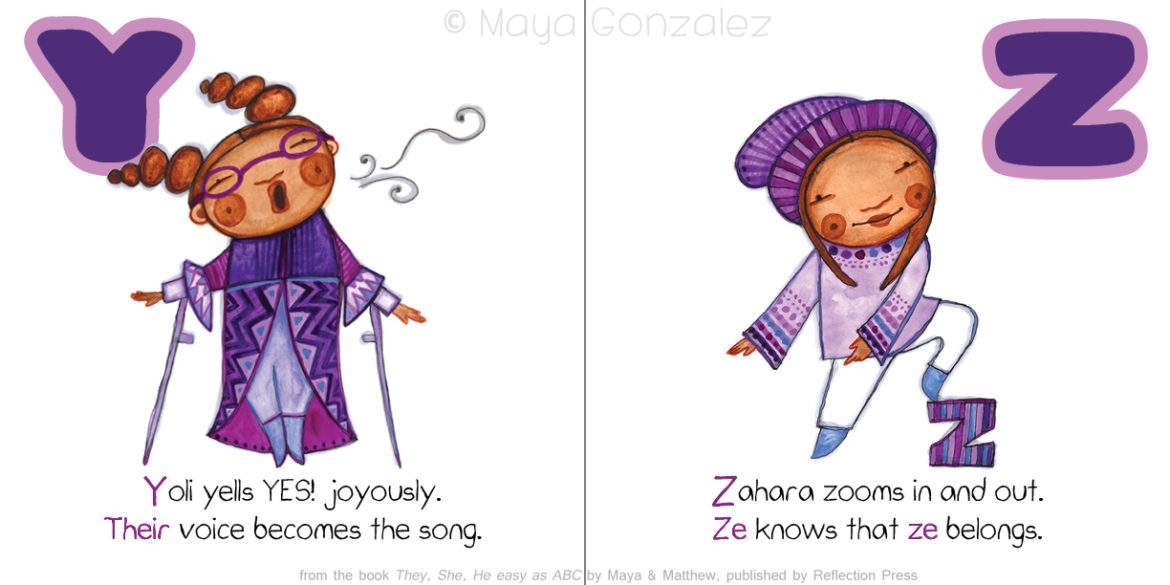
Image description: Interior spread from ‘They, She, He, Easy As ABC’ by Maya & Matthew, published by Reflection Press.
In this post: Dismantling cissexism & gender bias for story time – inclusion is as easy as learning the ABC’s
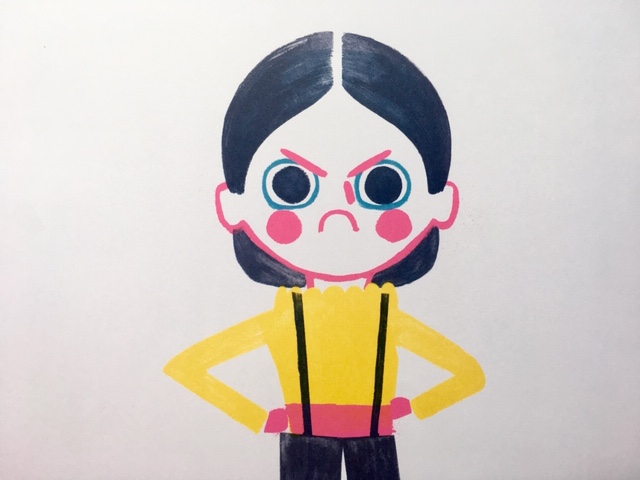
[Image description: Mary Walker from the book ‘Mary Wears What She Wants’ by Keith Negley. Mary holds her fists on her hips, elbows akimbo, and frowns with angry eyebrows.]
Kids are in bed, let’s finish our March recap on anger.
In the months leading up to March, I spent a lot of time thinking about anger – particularly through the lens of women’s history month and feminism. It was going to be a website collection.
(And then life happened, and now its still stuck here in rough draft form: Destigmatizing Anger in Women. )
I conveniently happen to be a lady person who has feelings sometimes. So I did an experiment! Through March, I refused to push away or tamp down my anger. I owned it. I rolled around with it. I gave myself to be abrupt and honest about my feelings when people got rude.
It was helpful – my anger became a tool for clarity, a sharp blade to cut through the bullshit.
I always police my tone with people who want to defer their responsibility on to me. This month, I let a bit of my anger take out into the world as a warning flare to back off and quit poking me.
When I was six, I had my first overt bully. My mom told me to make unblinking eye contact with the girl who towered over me, slowly advance until our chests touched, and growl, “Whatchoo goin’ do ‘bout it?”
Which thinking back, must have been fucking adorable. But somehow it scared the shit out of people twice my size and it got me out of lots of dangerous situations.
My mother – who had been attacked from a young age by both people she loved and strangers on the street, who had been chased and pinned down, strangled, and abandoned, who had seen the inhumanity in people with power against those with less, exuded a constant cloud of fury about the injustice in the world.
This was the air I breathed, this is embedded in my tissue. I don’t get sad. I get angry. Anger is my comfort food.
Mom explained to me that over the course of my life, I would be attacked, at any moment, unprovoked. She taught me to to never sit with my back to the door. She also trained me to fight and leave my opponents choking on their own blood. To make a public example of my attackers so there would be no second wave.
So it makes me chuckle a bit, when readers call me aggressive because I make demands for basic human dignity and respect. Oh, honey. You you’ll know when I’m being aggressive because there will be holes in the drywall and my teeth will be embedded in your jugular.
So what I’m saying is, The Ray femininity isn’t a sad wilting daisy waiting to be saved. Anger is interwoven with our identity as women.
But there’s a caveat – some of us can’t afford to own and exude our anger. For all women – our justifiable anger is passed off as PMS, hysteria, nagging. We’re gaslit into submission, showing our emotions means our concerns aren’t taken seriously.
My mother is white, her anger is the stuff of power and super-hero movies. I am Asian, and there are consequences for showing my anger, playing into stereotypes of dragon ladies and yellow peril. Neither one of us, however, has to fear the stereotype of the Native Savage, or the Angry Black Woman.
So I’ve learned to keep my anger silent, hidden behind a relaxed facial expression. I couch my angry responses in ‘I’ statements, in calls for collaboration that put the burden on me to do the heavy lifting.
This is only necessary so long as we refuse to share our anger on a collective level. Separately, our anger eats away at is, bitter and resentful.
But what if…what if we could teach our kids how to amass the big feelings, the fury of injustice, and use it as fuel for a generational wave of change?
And what would it take to model healthy, powerful, change-making anger for them?
Unlike sadness, anger requires a sense of expectation, even entitlement. Anger comes from expecting control, and having it yanked away. Anger is a side-effect of ownership and agency.
Sadness has a place. Just yesterday, grief took me out at the knees. Picking pebbles from the dirt above my daughter’s grave – I accept that sadness. I am powerless to reverse or make her death okay. Sadness is this heavy fog that sits with us. It does not kick us into gear. Sadness is about the things we are not obligated to try and change.
This month, we got flooded with articles of attacks on young Black boys, disabled people, Muslims praying in a sacred safe space. These events don’t make me sad. They make me ANGRY. Not just that they exist – but that this month is no different from any other.
I pay attention when I feel sadness versus anger. When pity shows up in my gut. When I feel hopeless, when I feel gloom. Pity, sadness – it comes along with a sense of looking down from up high toward a victim – that person separate from ‘me’ (even if I’m looking at right-here-me as a victim from another hypothetical timeline where my daughter is still alive.) That is a form of superiority. Pity is a ‘too bad for THEM.’
Like this bullshit:
“I pray and hope that by the time my toddlers are in school, this won’t be necessary.”
This was a comment on our post about talking to kids about shootings. Beyond voting for politicians not backed by the NRA, this person has no plans to take responsibility or change things in the two years before their toddlers enter kindergarten.
I find comments like this INFURIATING. Fuck prayers and hopes and waiting. And I was like… well fuck. Was I not clear? I mean I DID point out in the article that thoughts and prayers aren’t getting it done. But you know what? I SUSPECT that this person didn’t even bother reading the article. It wasn’t this person’s problem, so they didn’t bother.
But this isn’t someone else’s problem to fix. It’s ours. Both mine, and theirs. Right now.
This parent justifies inaction in hopes some some faceless legislator will step up and do the work for them.
I get that being a parent (of twins, I’m guessing) is hard work. But this pity-party is condescending, and these comments aren’t just helpful – they do active damage.
For the thousands of people who see comments like this, it normalizes the behavior of staying passive, sending thoughts and prayers and passing responsibility to someone else. It models for our kids that sitting still and feeling sorry for our future-selves, waiting for someone else to get angry and get shit done, is acceptable.
Comments like this – they make it acceptable to see more things as something we can’t, and aren’t obligated to, change.
Attacks on people of color, on Muslims, on people on the other side of the world – we get sad when we see this as an attack on ‘others.’ (To be clear, I’m not trying to appropriate the impact of this violence. Victims of this violence and oppression and people within these groups face the day-to-day impact and trauma of it, whereas I just have big feeeelings.)
What I mean is – if we are truly including marginalized individuals as equals, as a part of our wider community, we are all humans in this together and we have an OBLIGATION to keep our people safe, to prevent these horrors. An attack on anyone’s children is an attack on OUR children.
If someone came after my child with violence, I would put a stop to it. I would use my fury like a laser to cut that cancerous bullshit OUT. I would not sit there crying, waiting for someone else to rescue them. So why aren’t more parents angry about mosque shootings, police brutality, and systemic injustice?
There is a good video about this – on perspective, judgement, and the choices we make to feel with people, instead of for them. It is here.
If the people under attack are our people (and they are). Get angry about attacks on our people. Do stuff about it. Call reps, vote, rally, sue gun manufacturers, draft legislation, collect and educate people, raise better humans, adjust your professional work to align with your values – there are ooodles and oooooodles of creative ways to use that fire to make change, and not one of them stops at ‘thoughts’ and clicking sad emoticons.
Hence the books. And raising kinder, braver kids who hopefully won’t grow up to kill and main and rape people. We are obligated to raise children who do not spew more malicious action into the world. We are obligated to raise children who recognize malicious action in their peers and nip it quick.
We are also obligated to show our anger, to talk to our kids about what makes us furious. We are responsible for modeling how to put that anger into a laser-beam of action.
Let our anger be the fertilizer that rears a new generation who hold themselves, and each other, responsible for the safekeeping of our people.
Fertilizer though – it smells. It burns. It’s explosive. We need anger-fertilizer-laser-beams, to burn away all the crap that doesn’t matter. We need it to kick us in the ass and keep us doing things that make us uncomfortable and scared.
Anger exposes our values – it clarifies what we believe is right, between what we deserve, and what isn’t acceptable. Anger is the fuel we use for courage to right things when they go wrong.
Get your hackles up, then go DO A THING. Read books full of angry women to your kids and learn more about how destigmatizing anger in women smashes the kyriarchy!
Check out the unpolished book list: Destigmatizing Anger in Women
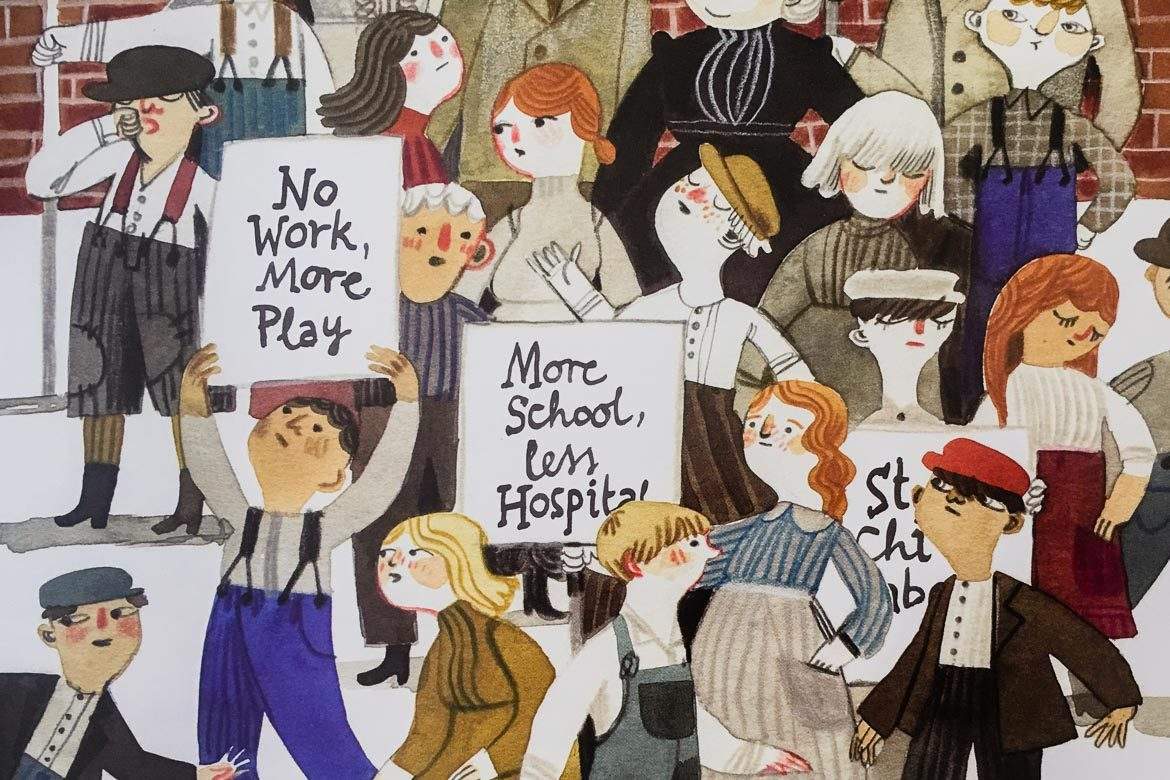
[Image Descriptions: Interior illustration from On Our Way To Oyster Bay, by Monica Kulling & Felicita Sala. A group of children and adults rally in a crowd, holding up signs that say “No Work, More Play,” and “More School, Less Hospital.”]
As you know, Labor Day is the day when the middle and upper-class go shopping for retail deals, toss their white polos to the help for laundering, close the pool, and drink champagne on sailboats.
BUT DID YOU KNOW…
Labor day is SUPPOSED to be a reminder of progress of the Fair Labor movement – encouraging us to fight for safe working conditions, livable wages, reasonable working hours, and the protection of underprivileged employees.
Seems backward that we celebrate by forcing retail employees to work black-out holiday hours, endure insufferable latte orders for crap tips, and get yelled at about coupons.
Um… there is something seriously messed up with how we are doing labor day.
Dolores Huerta was a teacher and mother who took action against the inhuman working conditions of migrant laborers and a key organizer in the California Grape Strike of 1965 – a when workers and consumers pulled together through labor organizing, media action, and boycotts to protect workers.
Mother Jones led a strategic campaign to force wealthy Americans to see the effects of child labor, shaming the US government into enacting child labor laws.
Gordon Parks and Ella Watson instigated our country to recognize the invisible labor of Black women both inside and outside the home.
Today we honor Dolores, Mother Jones, Gordon, and Ella – We keep fighting against the exploitation of workers.
Posts may contain affiliate links, which allow me to earn a commission at no extra cost to you. Check out the full affiliate disclosure along with my statement of accountability. If you’re into supporting libraries (please do!) more than consumerism, you can also support my work directly:
Donate or shop using an affiliate link via| Paypal | Venmo | Ko-fi | Buy a t-shirt | Buy a book
¡Si, Se Puede! / Yes, We Can!, Side By Side, The Golden Thread


Click, Clack, Moo; Cows that Type, The Day The Crayons Quit


Connect kids with the power of worker’s rights by helping them empathize with other kids just like them.
Kid Blink Beats The World, On Our Way To Oyster Bay
I am not a giant fan of I Like, I Don’t Like – it’s reductive and lazy, plus the Photoshopped images are creepy AF. But if anyone wants to write their own spin on this, one that does the work of explaining the difference between exploitative work and the work required to be part of a community, I am here for it.


Brave Girl, Shining Star, How Mamas Love Their Babies addresses the presumption of feminine/immigrant incompetence, tokenism, and the invisible unpaid labor of mothers (and sex worker rights), respectively. For kids 10 and up, check out Fannie Never Flinched, (not pictured) which is a bit too didactic for my littles, but a great resource.


Why is women’s work still worthless in kidlit? Heads up for problematic books:
Get picky about the way stories devalue women’s labor.
Note: Brick By Brick repeats the objectifying phrase “Slave hands’ throughout a poem to reclaim and validate the generational trauma caused by slavery. We discuss this in more detail here, but for now, understand that non-Black folks – this book is not for you. It might make you uncomfortable to realize that there’s a thing not made for your consumption. Some things are not for you. You’ll be fine.
Authors – heads up! I’m still searching for a picture book that explains how we continue to willfully exploit Black folks through predatory cash-bail, school-to-pipeline systems, and the terrorism and oppression of Black lives in our judicial system. ::Waits impatiently::


For more problematic literally sugarcoating slavery, look to ‘A Fine Dessert,’ which inspired the hastag #SlaveryWithASmile (coined by BLM Activist Leslie Mac) in a detailed article by Kenrya Rankin from Colorlines. In another, Demetria Lucas D’Oyley from The Root shows us another horrific example of whitewashing in ‘A Birthday Cake For George Washington.‘
“Many white people did things they never should have done. Denied opportunity, denied housing, denied voting rights, exploited the love and labor of Black women.” – From Not My Idea: A Book About Whiteness
Migrant is particularly tame and beautiful, and a good starter since there is no family separation. Pancho Rabbit is scary and necessary to understand the dangers families face in order to do basic work that US citizens both want and need done.
A New Year’s Reunion takes place in China, not North America. I still haven’t found a decent book about Satellite Babies – American children of the working poor – who must be sent to grandparents in China at birth for lack of affordable childcare.
I am waiting for stories about the violent, forced separation of families at the US southern border happening right now currently in print. All because we put up stupid boundaries and criminalized the healthy flow of circular labor migration. To be updated.
Migrant labor in and of itself is not a bad thing. Negative community impacts happen only when we criminalize and exploit impoverished workers, gentrify neighborhoods without increasing wages to match, and hoard resources that migrant families need to complete a healthy economic cycle.


So, gosh – what now?
These books are designed to make you feel uncomfortable. Most of them are not fun to read. Now that your kids know how our economic system exploits people in poverty, women, nonbinary folks, Indigenous people, and folks of color – whattya gonna do about it?
How are your kids going to take these awful feelings and channel them into good trouble?
I don’t have the time and resources to do everything on this list while raising two kids and running BFL. But every day, I do what I can to fight for fair labor rights, and so should you. So do just one thing – and if you can, do more.
Learn about the impact of small actions with your kids to level the playing field:
Our economy is broken because we’re hiring and promoting business executives who care about shareholders and profit. ‘Leader’ is a misnomer – these are Wheedlers, not Leaders.
Leaders protect the people who follow and dedicate themselves in service to a common mission. If the leaders in your your company, your school, or any part of your community are serving themselves over others, or allowing injustice to happen – stand up and call this out – this is not okay. (The Smallest Girl In The Smallest Grade)
The Good Garden, The Smallest Girl In The Smallest Grade, One Hen


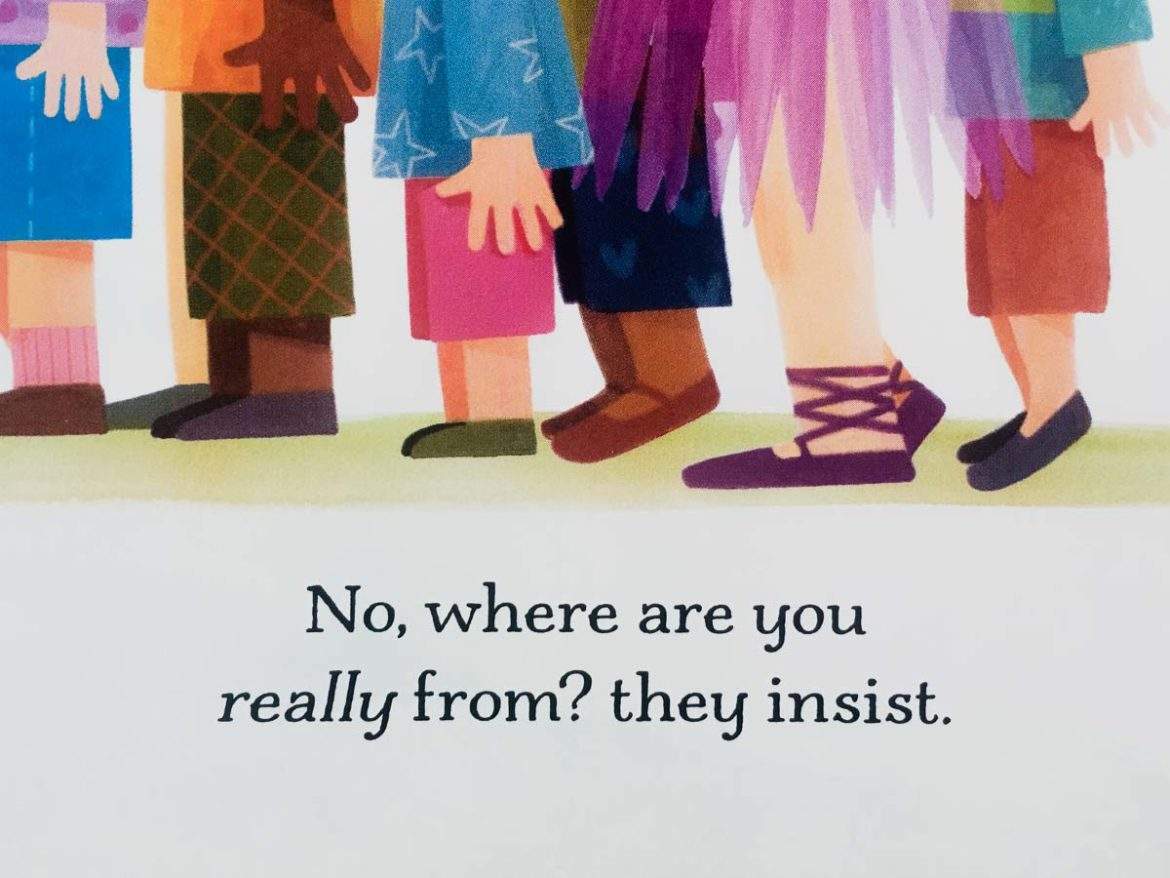
[Image description: Illustration from ‘Where Are You From?’ by Yamile Saied Méndez and Jaime Kim. We see the feet of a crowd as they stare at a multiracial person, insisting “No, where are you really from?”]
Raising Luminaries is free and accessible for readers who can’t afford a paywall. Posts may contain affiliate links, which allow me to earn a commission at no extra cost to you. Check out the full affiliate disclosure along with my statement of accountability.
Anti-Racism For Beginners 103: How division & disqualification silences voices of color
…
I don’t mean who’s talking about race the loudest. I’ve got white folks throwing their ideas* on how to solve racism at me from every-which-way. So many recommendations!
I mean really who is entitled to talk about our experiences with racial discrimination without being disqualified as unreliable and irrelevant? (Aside from white people, as mentioned above, whose reliability is rarely questioned, plus they’ve had their say).
*Ideas include: derailing action with white tears, DIY saviorism, and tips and tricks on how to invade and derail BIPOC affinity spaces. White friends – I get that you’re upset you are about racism … (for) now. We’ve learned to carefully monitor your perspective and emotions as a survival skill. So we’re already well aware of how it impacts you. I don’t need any more articles on how you suddenly woke up and racism existed. These frustrate and depress me, so maybe live your truth on your blog and share it with your white friends but stop asking me to center, read, and promote more white feelings & savorism. Thanks!
In searching for Books For Littles, I prioritize #OwnVoices stories. It’s not just because lived experience gives our stories nuance that outsiders miss when they tokenize us (truth tho). It’s not just because white folks gate-keep the publishing industry and the stories of targeted folks need an extra thousand boosts to achieve the same visibility (very important!)
We need to center #OwnVoices stories because in a culture that trusts whiteness and values white modalities of communication (scoffing and eye-rolling at anything else), we’ve been trained to hear voices from targeted people through a critical filter. People who are targeted and exploited have to fight to be believed.
I talked with the Earthquakes about our racial identities with the Something Happened In Our Town family discussion questions. And it was…complicated. As a family of Chinese/Irish American settlers (plus whatever my white partner is – he’s not sure because he’s never been forced to think about it), being multiracial means our racial identity isn’t just about our ethnicity or heritage, or even how we self-identify. We’ve got to factor in how outsiders perceive us. And by outsiders, I mean the white people who say shit like “Oh! You don’t look Asian!”
Similar to the word-fart “But you don’t look Autistic!” This is supremacist code for “You don’t look like my narrow stereotypical idea of what over half the world’s population looks like. I thought you were one of us normal people.” This is intended as a compliment. It doesn’t feel like one.
White people with economic and social power created and still maintain control over the definitions of racial identity. It’s just another tool used to exhaust us and keep BIPOC on our toes so we can’t organize together. Once we finally define our identity outside of reductive stereotypes and stigma, we start to get a grip on accepting and affirming who we are and where we come from. But this can be revoked and denied by white folks on a whim. That is really fucking exhausting.
Back to the discussion questions: “What is your racial identity?” And my kids were like…uhh. Lemme think about it.
All this work we do with the Earthquakes – owning our white racial identity and privilege without buying into whiteness, celebrating and refusing to other our Asian-ness. Owning our responsibilities to dismantle the model minority myth and integrate anti-racism into our daily lives. And it turns out they still struggle with the same questions I had as a kid. What are we? Do we count?
The 5-year-old decided he identified as white. Over half of his ethnic heritage comes from Europe, so why not use that as a safety blanket? He’s got my features, but his dad’s light coloring. He knows he lives in a society that values and protects white people. He knows whiteness releases him from challenges that the rest of us need to navigate. He’s still years away from having to defend his masculinity in a culture that insists on feminizing his Asian features.
 Identifying with whiteness gives him chances to get out of tricky situations unscathed. He has the privilege of being perceived as white,* so why not? Knowing he sees me as Asian – I had to work to keep my expression neutral. It felt like he was rejecting me. But it’s not my job as a parent of a mixed race kid to tell him how to identify.
*Passing is the first word I thought to use here. This phrase is problematic term that centers white as the ‘default’ human.
At the same time – I know it’s going to hurt one day – when this kid realizes that the light coloring he benefits from will also drag him down, and be used against him to disqualify him from speaking up about generational trauma, growing up Asian American, and this will be used to pressure him into denying Asian identity, a huge chunk of who he is that defines more about our lives than his eye color.
So I’ll keep Allan Say’s ‘The Favorite Daughter’ on hand for when that day comes. When those same tired old disqualifications show up. When he’s used as a token to prove his white friend isn’t racist. When he challenges a racist joke and is shot down for being too sensitive and making everything about race. When he challenges a slur and is shot down because it doesn’t hurt him because he doesn’t ‘look’ Asian. When people feign shock that he celebrates Chinese New Year and Qingming.
I don’t know what’s waiting for him in a life that gives him full access to whiteness. I worry about what this kind of power could do to inoculate a kid against empathy and make apathy easier.
The 8-year-old, identifies as ‘Light Asian,’ explaining it the same way you’d mix in 1 part red paint to 3 parts white. He explains it this way – you can’t claim whiteness in this country because whiteness is based on a (nonsense!) notion of European purity. And our whiteness does come with benefits, privileges, and responsibilities we can’t ignore. Q has had a couple extra years learning about white supremacy – he’s aware that he just can’t drop a huge chunk of who he is to get the benefits of whiteness. Not without consequences – to himself, and to others.
 But that doesn’t guarantee they won’t feel that unsettling disorientation that comes with living as a shade of pink in a world that only talks about race as if it’s experienced as a hyper-saturated either/or. When these conversations come up – I find the book ‘Spork‘ by Kyo Maclear helpful to validate this ambiguity and frustration.
As for the term ‘Light Asian’ – oh, that makes me cringe. There is that whole colorism issue within the Asian community – used to divide us and prioritizing our proximity to lightness (eww), but it’s more than that.
White folks have disqualified my reports of racial discrimination by telling me that I’m not ‘Asian enough,’ or ‘a real Asian’ because I’m American-born Chinese, because I’m multiracial, because I was raised by a white mom. That the aggression against me could be worse (no argument there), so it doesn’t count (nope! It’s still shitty and exhausting!). Of course, under no circumstances would I ever be able to speak about discrimination as a white person.
So without validity of being enough, or having the presumed dispassionate authority of whiteness (hah!) – that’s such a convenient way to silence any person of color. Since qualifying people of color by shades never serves us and only serves to divide, denigrate, and silence us – I get a little touchy about qualifying us by shades.
You might also like: Microaggressions Against Multiracial Kids – Books Where Kids Can Belong
White supremacy, and the entire concept of race – it’s new to humans. Which means it took a lot of work to create, and will take a lot of work to dismantle.
We sustain white supremacy as a norm because we’ve been trained to think in discrete divisions. Good, bad. Heroes, victims, and villains. Black, white, and…those other brown folks. So long as we stay separated, we can’t grow large and powerful enough to overthrow the tiny group in power who keep sucking up resources at the cost of everyone else. I’m not saying stop talking about or acknowledging racial labels of the consequences of them. I’m saying name them and take responsibility for dismantling them.
Scarcity, rich and poor, racial superiority, gender binaries, all this junk isn’t inherent to humanity or biology. It’s made-up! Kids learn this shit from movies and books – and even in school. We teach our kids this is just the way the world is and we’ll have to navigate through it. But they’re not circumstances to navigate around before we get to the problem, they’re the problem. These thing are whiteness. We can’t dismantle white supremacy without lifting the veil – these are the pillars of white supremacy.
Folks with power and cunning built the concept of white supremacy and have been feeding us psychological tricks to sustain it. It’s such an efficient system we’ve grown to perpetuate it even when we disagree with the premise. And it’s integrated in stuff that should be great, but instead just perpetuates racism. Who doesn’t want specially trained courageous forces to protect and serve us? Who doesn’t want quality free public education? I want those!
But I don’t want them if these institutions are only protecting wealthy white people from Black people who want freedom. I don’t want education that tells my kids the only ‘classics’ that count are the ones from Europe.
Remember above? My kids get a choice on how they identify. There are some margins of ambiguity we are free to work within.
 US lawmakers and land-owners designed that one-drop rule with intention – to maintain a pretext of acceptance in enslaving Black folks. Disqualifying a single drop of African ethnicity from claiming whiteness made it easier to enforce slavery. A quick-reference law to eliminate ambiguity, make enslaving other humans easier.
Bonus: dissuade poor white folks from cross-racial mixing or organizing against white elites. Early laws designed to stigmatize, punish, and disqualify basically anyone who couldn’t claim 100% whiteness. Divide. Disqualify. Maintain power.
All this division – it doesn’t apply equally. These social rules of division are applied if and only when they benefit rich white folks. For instance – in the landmark case of Loving vs. Virginia, (Ex: The Case For Loving) the fight was whether a white man could marry a non-white person. Our laws allowed for non-white races to intermix somewhat freely. Mildred Jeter herself was of African, European, and Indigenous ancestry. Richard Loving was marrying a woman of European ancestry! But the targeted part of Mildred’s ancestry disqualified her claim to her white identity. White supremacy denied both of these European-Americans from benefiting from whiteness.
This was all to maintain white bloodlines, and by extension – authority and supremacy of a select few.
You might also like: Diverse Family Constellations In Kids Books
 It doesn’t matter how many generations my family has been here or my habit of slipping into a Boston accent when irate – I’m still perceived as an outsider. People still ask ‘Where are you from? No, where are you…your people…uhh…what…are you?”
As an Asian American, 4th-generation Bostonian, having never set foot outside the land currently known as the Americas, I’m still a perpetual foreigner. (ex: Where Are You From?)
I feel like we’ve gone over this – how subtly othering non-white people, treating us like outsiders in our own communities is psychologically taxing and docks our ability to speak with authority.
So more on that about othering multiracial folks and BIPOC existing in primarily white spaces. No matter who they’re surrounded by, no one assumes a white person with an American accent is an immigrant. They’re not an outsider, despite the fact even European settlers are the outsiders ’cause this is Indigenous land.
One of the nastiest lies I learned from white teachers was that ‘The Native Americans’ (Indigenous people of Turtle Island) are all dead now. And sure, it’s sad what ‘happened’ (translation: What we did) to them, but they are all gone and no longer suffering. (Totally not true – Indigenous people are still here!)
My teachers taught me that white people are now (by order of a Christian God and manifest destiny) the rightful and primary people of this land, spiced with a few model minorities to prove bootstraps individualism and capitalism work, and we’ve got to watch out for foreigners who could spoil the whole country.
Labeling folks based on our ethnic identity as outsiders or foreign is an ironically foreign thing to do, as from what I’m learning, Indigenous nations weren’t really as fearful and awful to immigrants as settler Americans. What colonizers saw as a weakness, I just see as…well, basic human decency? You meet a stranger, you say hello. You don’t shoot them and move into their house.
You know what the opposite of supremacy is? Respecting the human rights and belonging of all the humans! Focusing less on how to divide-and sub-divide each other, and more on working in collaboration as members of shared humanity.
 Oh – collaboration isn’t easy. Inclusion is super hard. But folks with racial privilege could just nibble a tiny bit of bitterness to make space on the plates of BIPOC (the Mental Vegetable of Inclusion is an acquired taste).
Anti-racism must be practiced alongside decolonization, otherwise it’s performative and toothless. White supremacy was originally designed to steal stolen land – to dismantle Indigenous ways of being, divide the People, and kill everyone off. So following Indigenous guidance and leaders in dismantling white supremacy seems like an obvious and necessary step.
And you know what I keep hearing from progressive Indigenous leaders? That Indigeneity transcends ethnicity (ex: Fry Bread), and that this blood-quantum thing was created to divide and disqualify Indigenous people from their rights and eat away at their land rights. The guidance is simple (although yes, hard in practice), as in The People Shall Continue – come together, and resist.
You might also like: Kids Books To Acknowledge Indigenous Day Of Mourning
Our education, employment, government, and media institutions train folks with less social power to remain submissive by teaching them they’re not enough – not smart enough, not strong enough, in a culture that shames them for failure and shows contempt for curiosity and caring about consequences. 
Pair that with cancel culture, in all the ways being ‘cancelled’ means a small fine and a come-back tour for the rich, white, and powerful men – with long-lasting and devastating effects for multiply marginalized people.
That’s a self-sustaining recipe: compliance training to keep those denied power insecure and afraid about speaking up about injustice.
This leaves a vacuum of silence. A vacuum where only people with social power feel entitled to talk about oppression.
Where only white people have a reliable platform to talk about racism (most often as the heroes who will solve it, of course). Where only abled parents of disabled kids feel entitled to talk about disability (and what a burden we are to them).
This division, disqualification, and focus on punitive justice is a vacuum where only the most braggart, boastful, entitled, and oblivious folks who haven’t had experience being smacked down with ‘you aren’t enough’ dare to tread.
This is why we need books destigmatizing our identities – speaking truth to bullshit about reductive stereotypes and allowing us to be complex, vulnerable humans. This is why we need books validating our experiences – showing our kids that we are not alone, we are not the only ones. This is why we need stories normalizing us showing that we have a right to claim ownership to our humanity beyond our targeted identities.
And this is why we need books of affirmation (ex: I Am Enough) created by and for #OwnVoices authors. And we need lots of them. Because we’re all different and we all need different affirmations for our unique identities. Let’s not erase or ignore those differences. Let’s accept them, talk about them, celebrate the ways we overlap and the things we share. Learn from the stories outside our lanes, and believe those who we have power over.
White supremacy seeks to deny permission by flattening us into either/or. Qualified or unqualified.
We don’t need permission. We can reject that nonsense. We can refuse to to divide, qualify, and deny some folks at the expense of us all.
Hey settlers – do you know whose land you’re on? Check out this working map of Indigenous territories.
Find out whose land you’ve invaded, do a quick google search on how you can support local Indigenous-led efforts to decolonize your community. (If this word is new to you, it’s not as scary as it sounds. No one expects you to give away your earthly positions and jump into the ocean. Punitive justice is a white supremacist modality and we can reject it!)
Together we can collaborate and ignite a generation of kind & brilliant luminaries.
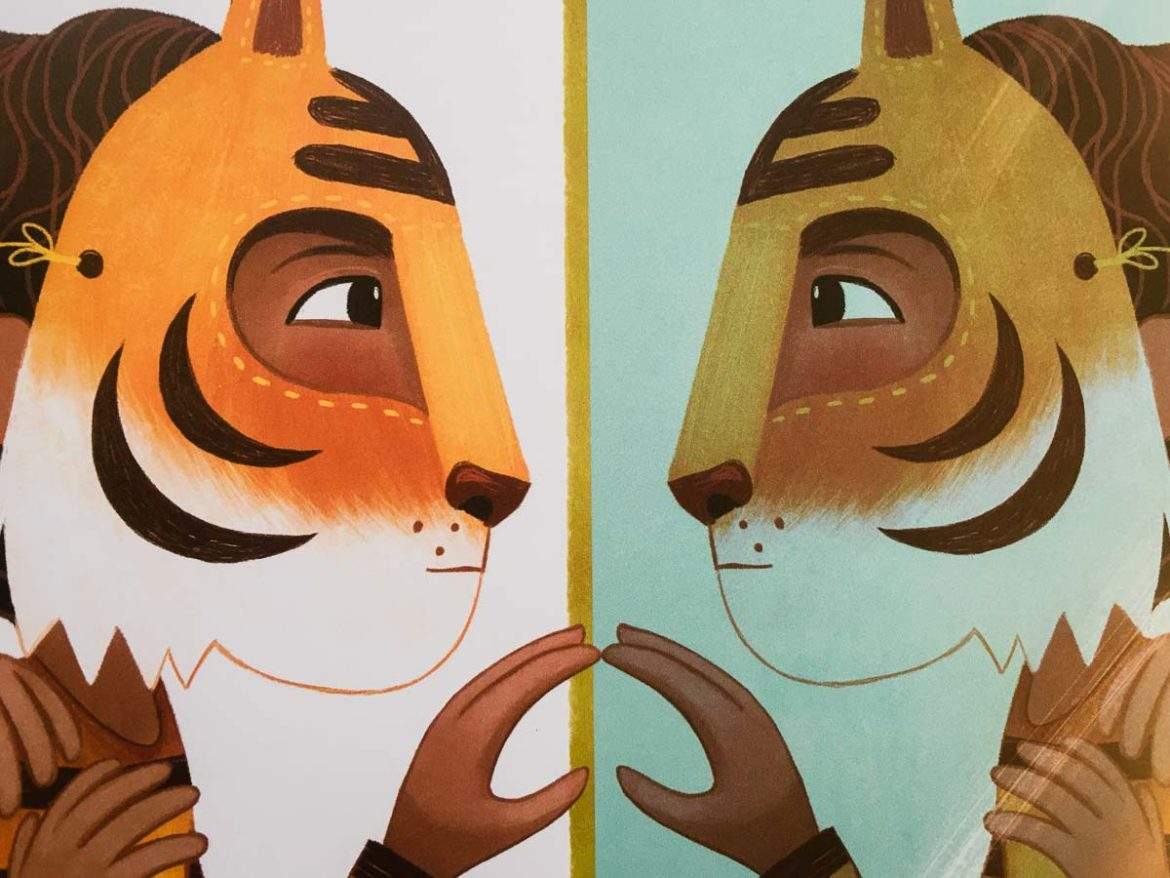
Sharing this post on social media? Use this description to make it accessible: [Image description: Illustration from ‘A Tiger Called Tomás, by Charlotte Zolotow & Marta Álvarez Migués. A Latinx boy wearing a tiger mask examines his reflection in a mirror.]

Charlotte Zolotow & Marta Álvarez Migués (2018 editon)
Picture book, Best for kiddos ages 3.5 – 8 years
Keep Raising Luminaries & Books for Littles free and accessible for readers who can’t afford a paywall.
Posts may contain affiliate links, which allow me to earn a commission at no extra cost to you. Check out the full affiliate disclosure along with my statement of accountability. If you’re into supporting libraries (please do!) more than consumerism, you can also support my work directly:
Donate or shop using an affiliate link via| Paypal | Venmo | Ko-fi | Buy a t-shirt | Buy a book
A couple Halloweens back, I watched a dad viciously snap at a some kids as they walked by his house.
“No costume, no candy!” His words sliced the air, accusatory and weirdly aggressive. And these kids – who clearly had woken up one day very recently in men’s bodies, unsure of how they fit in the world with these broken voices and awkward gangly limbs – they recoiled, ducked their heads, and looked ashamed.
I guess it was shocking because this dad didn’t give off ‘asshole’ vibes at first.
I mean – he gave me candy. Our kids, had just met and were playing together like a pair of sugar-coated bouncy balls, leaving us parents to fill the silence with inane chitchat. I wasn’t wearing a costume! But I was masking and borrowing heavily from my Script to Appease Rich White Allistic Parents. The lengths we go to to support our kiddo’s social life.
White folks in our city still continue to complain (to my damn face!) about the Asian Invasion – “I’m not being racist. These new Chinese aren’t like you.” (Re: assimilated, able or willing to appease whiteness)
And allistic folks usually end an ableist complaint about accommodating students with disabilities in our schools with ‘I don’t mean all autistic people…you don’t count because you’re high functioning!’ (Re: handy to have around.)
So it was just one more abrupt reminder that Nice Allistic People turn vicious the moment we fail to assimilate, offend their sensibilities, allow our bodies and skills to be commodified, or just please them.
Those kids he yelled at – they were just a couple years older than ours. They hadn’t done anything wrong and they had nothing to be ashamed of. Who knows whether they were wearing ironically boring costumes or not? I’m old – I don’t know tik tok humor! I once went trick-or-treating dressed as my identical cousin. It was a fantastic costume and everybody loved it!
So my question is – who raised this entitled bucket of farts to believe he’s Sheriff Fashion Police of Halloween City? He lives in a million-dollar house! If he’s worried about running out of candy, he could have bought more damn candy!
It was a really hard moment to watch. I chased the kids down and directed them to my house – where the candy flows freely without discrimination, and somehow we never run out. ‘Cause those same teens Sheriff Fashion Police is afraid of? They’re the kids who leave candy behind when they find an empty bowl.
I reassured the kids that they had done nothing wrong. But still, they apologized to me (what for?!) – ashamed, awkward, and confused about where to go in an ageist society that leaves no free and accessible fourth spaces for kids and teens. Wondering what to do – and where to go – with all these gawky limbs, big feelings, and crushing self consciousness.
According to Sheriff Fashion Police, they’re not even welcome to participate in their own damn neighborhood!
This was a gross reminder of how much we expect from teenagers – who are still children – navigating the complicated, confusing landscape of adolescence. We don’t give them the freedom and respect we give adults. We snap at them and expect them to submit to arbitrary, bullshit rules that are not just ableist, classist, and culturally narrow, but also ageist. We refuse them the childhood leeway of fumbling as they learn weird, arbitrary social norms and traditions no one can remember the reason for.
So what I’m saying is – don’t be the neighborhood creep who wields candy as a currency of enough-ness and growls at folks who fail to meet some arbitrary category of festive apparel.
Kids do well when they can. Like folks who get competitive about holiday and thank-you cards, Sheriff Fashion Police gives me the creeps. Why would he assume the worst of kids, unless he’s dipping into memories of being a class-A bully in his own youth? We don’t trick of treat at his house anymore.
Really though – what’s up with those lazy trick-or-treaters, who show up without a costume? Or the ones who are too old to be begging for candy? What about those rude kids who don’t bother to say ‘trick or treat?‘ or please and thanks? Oooh! Or those suspicious neighbors who won’t look you in the eye?
…Does it matter what their story is? If we can afford to give out candy – does it hurt to give these kids candy, too?
Not because we fear them and their late-night hijinks – but because lots kids (and plenty of adults), see highly-scripted events like Halloween as the only night they can safely join the community and meet neighbors with less risk for emotional violence.
For example, many people on the autism spectrum, including myself, use ‘scripts’ to navigate confusing social interactions. Halloween gives us ONE safe night to get out of the house with a specific, fool-proof script. To feel like a part of the community without collapsing in exhaustion at the end of the day.
I can look you in the eye, and greet you warmly – but it didn’t come naturally. I had to practice. Trick-or-treating was a safe space to practice without too many curveballs. Let your neighborhood kids and their awkward caregivers practice! If you can spare a clump of nougat for the non-disabled kids who can afford etiquette training, then do the same for kids who don’t have all those resources.
That kid who remained silent, grunted, or who didn’t say exactly the right thing? That kid very likely has a communication disability, speaks another language, could be d/Deaf, or has an auditory processing disability! Good gosh. Be decent to people. It really just isn’t that hard not to reserve judgement for the 15 seconds it takes to hand out candy.
The kid without a costume likely has caregivers too overwhelmed with work, disabilities, care-taking, and lack of support to cobble up a costume. Or, given that about 28% of children under 18 in the US are from immigrant families, maybe they’re just getting their footing on how to prep for this bizarre autumn holiday where we dress like sexy unicorns and extort our neighbors for treats.
Given that 5-13% of the population has a diagnosed sensory processing disorder (not counting those undiagnosed due to healthcare barriers!) – many of us can only wear one specific set of clothes so we can get through the day without pain – and we don’t owe anyone our pain in exchange for humane treatment.
That kid who is too old? (Is there a rule? Like, you hit 13 a and you’re not allowed to celebrate holidays anymore?) This big kid is not at your door for candy! That kid has a mustache and a weekend job – they can buy their own candy! Older kids and teens are worried about getting mocked for dressing up for Halloween – but also they are social animals, members of our community, and they just really want to connect with you and hold on to the last remnants in the tail end of childhood.
For those self-appointed Sheriffs of The Right Way To Do, you’re telling them they can’t participate in Halloween because of their disability, their class, their culture, their perceived age, and their confusion. Which is a SHITTY THING TO DO, and doesn’t seem worth risking a kid’s safety-net sense of community just so you can bogart one more snickers.
Okay, right. The books. What do A Tiger Called Tomás and Tomás’s earlier avatars have to do with all this?
A Tiger Called Tomás and A Tiger Called Thomas are two modern variations on the same 1963 story. I ADORE both of them.
Tomás (aka Thomas) has social anxiety. This is common with kids targeted because of their identity, those perceived as ‘other’ by the dominant group. After years of being rebuffed, rejected, or outright bullied when trying to connect with other humans – you learn to avoid the risk.
Social anxiety is a prevalent side effect in people with a social disabilities, such as autism. Neurotypical folks born with … I dunno, those weird psychic abilities that help you allistics know how a person is feeling without examining body language, voice tone, and facial muscle clues? …those folks get angry when they expect us to magically obtain the privileges they were born with, and some of us just can’t keep up.
Saying the wrong thing, failing to read the room, missing social cues, taking longer to realize a conversation has turned sour, and generally being out of step with social norms – these social disabilities make neurotypicals nervous and jittery. And we all know the happens when entitled people with unlimited power get nervous.
While not an inherently biological part of being neurodivergent, growing up disabled in an ableist society puts us at a deeper risk of developing social anxiety and avoidance to minimize harm. After years of being worn down by a mix of open bigotry and the ever-present microaggressions of assumptions, kids of color, kids with disabilities, and third-culture kids learn to keep their heads down, and to approach new people with caution,. For those times when we have no choice but to interact with others – we often try to artificially assimilate, to mask our confusion, our natural thought patterns and even our pain and the exhaustion of it all.
For our family, Tomás codes as Autistic, and the safety net of his Halloween costume is a not-so-subtle allegory to Autistic masking. I see myself and my autistic peers in his hesitation approaching unscripted interactions, in the way he internalizes his social unworthiness, and his fear of rejection, social backlash, or even allistic violence. All this hiding, all this masking – it wears on you. That Script to Appease Rich White Allistic Parents (and even it’s annoying little sister, the Small Talk With Other Caregivers at The Bus Stop edition – UGH) is So. Fucking. Exhausting.
As a teenager, I listened to a recording of myself for the first time and was horrified (hello, internalized racism!) to realize how ‘Asian’ I sounded. I immediately proceeded to aggressively voice-train myself to whiteness. Although I can sound white without thinking about it, I can feel the effort it takes, deep in my neck. But twenty years later – physically can’t get my throat to relax. I can’t remember how to speak naturally. I’ve lost my real voice.
You mask for long enough, hard enough, and it’s hard to remember who you really are.
I turned 38 yesterday. I’m two years past the average life expectancy for Autistics like me (content warning for murder, abuse, eugenics, and death by suicide). And I can feel that pull to give up, to stop scrambling and just crumble to the earth. As a kid, I never imagined that I would be able to hold on performing this long. Writing, revising, and adapting social scripts, warily connecting with folks who might destroy me if my mask slips, it’s a non-stop job. The only break is when you’re completely alone, or asleep. So opting out, staying home, and avoiding other humans is part of how I survived these extra two years.
The breakout star in A Tiger Called Thomas (2003) is his mom – a single woman who is loving, independent, and trusts her son to work through his challenges without the soft childism of low expectations. She encourages, but doesn’t force him to go out and meet people. Occasionally facing away from the reader, she’s not an object created to accessorize her son, but she is mysterious – refusing to helicopter over Thomas, refusing to solve his problems for him.
Some critics see her as cold – but I see her as an independent person with a life to live and places to be, outside the pages of Thomas’s story, beyond a singular identity of motherhood.
This update of the book (Thomas was white in the original 1963 version) adds a validating narrative to this story. What assumptions are people making of you, when you’re a new kid on the block? Particularly – when you’re the Black boy in a mixed neighborhood – with all the assumptions people force on you?
Thomas’s story is quieter than the more recent 2018 Tomás. His story leaves more space for us to extrapolate Thomas’s internal dialogue, the genesis of his fears, and how he’s working through them. When reading this aloud, the Earthquakes ask more questions and offer more theories behind Thomas’s hesitation.
When we read Thomas’s story, we talk about what it means not just to be Autistic, but to be #AutisticWhileBlack – how Thomas has learned to be afraid of in a country where more than half of young Black men with disabilities are likely to be arrested. What it means to be arrested and sentenced to 50 years for speaking to people after a a car accident while disabled and Black.
In 2018, this era targeting Latinx immigrants, forced family separation, and the aggressive police state of ICE enforcement, Tomás’s story reflects not just social anxiety, but a real and present fear many Latinx kids are facing today.
In A Tiger Called Tomás (2018), Tomás’s mother is still single, still loving – but more hands-on. Her warm presence under-girds the story as she cheers him on. Less allowing him to be with his thoughts, but more ‘I’m here for you.’
With drastically different parenting styles, Tomás and Thomas’s mothers are both good moms – a reminder that there is no 1-2-3 guide to perfect parenting.
In my city they ripped a father from our community. Ripped away from his two children and his wife as she battles brain cancer. Across our hyper-liberal city, non-Latinx students and staff in our schools taunt and spit slurs at Latinx students – some taunting even our youngest students with threats to call ICE and have their parents deported. Under that daily threat – I can see wanting to hover near my child like Tomás’s mother – to be saturated so deeply in all parts of his life.
Updated to fight back against the anti-Latinx sentiment in the US today, Tomás’s bilingualism and his ethnicity force him to wonder what his new neighbors will think of him – what they will expect of him – and the fears of what they might DO to him and his family if he dares to say hello.
These conversations have to go somewhere. We can’t just read a book for ‘awareness’ and consider our work done. Here are a few ways we transform our family discussions from A Tiger Called Tomás into building an actively inclusive neighborhood:
This isn’t a one-and-done conversation. We need to bring the conversations started with A Tiger Called Tomás back to kids from multiple angles.
Nope – but it…used to be? Interesting backstory!
Author: Charlotte Zolotow (she/her)
Illustrator: Marta Álvarez Migués (she/her)
Álvarez Migués is from Coruña, Spain. From her illustrations, I perceive her as white – Hispanic, but not Latinx. Based on some light internet stalking, it appears that neither maker grew up in a place where they had to learn a second language to make friends with the neighbors, and neither has disclosed any neurodivergence.
Now on to the genesis of Thomas: Zolotow died at the age of 98 in 2013 – five years before this latest update from Thomas to Tomás with his Latinx identity. She was alive to enthusiastically approve the 2003 edition, updating Thomas from a white boy to a Black boy worried about potentially racist neighbors.
Zolotow created the original 1963 Thomas to reflect her social anxiety growing up as the new Jewish kid on the block, with a visible disability (including a conspicuous back brace), as her family moved frequently throughout her childhood. In the most recent posthumous 2018 edition, Zolotow’s daughter, Crescent Dragonwagon (what a name!!!), tells us her mother had enthusiastically endorsed updating her books to be more inclusive for children with targeted identities. Dragonwagon assures us that Zolotow would have been thrilled with the latest update to push the envelope on identity and inclusion in a political landscape of anti-Latinx violence.
Based on her body of work, I suspect the same. Similar to Ezra Jack Keats, Zolotow used her whiteness to subvert the racist gate-keeping of the publishing industry, writing stories to reflect kids with targeted identities. While Keats focused on normalizing kids of color from urban neighborhoods, Zolotow attempted stories to validate the experience of being perceived as the other.
Sometimes, she missed the mark. We now know that the most effective accomplice work requires stepping back and amplifying #OwnVoices makers. Unfortunately it’s too late to ask Zolotow if she had ever made an attempt to amplify targeted authors.
Long before #ItGetsBetter became a thing, stories such as William’s Doll provided validating reassurance for gender-creative boys struggling through the demands of toxic masculinity. Within a modern landscape, the text in William’s Doll is problematic, introducing language such as ‘sissies’ and the suggestions that boys loving dolls and practicing feminist dad skills would be weird in the first place. However – it was revolutionary at the time, and William’s Doll set the path for modern normalizing stories like Clive and His Babies and Teddy’s Favorite Toy.
In A Father Like That, Zolotow attempted to validate the experience of Black boys with absent fathers – an early (and imperfect) precursor to #OwnVoices stories like Knock Knock and The Nightlife of Jacuzzi Gaskett. Zolotow centered the child, but erased systemic racism and the prison pipeline that had targeted these fathers in the first place.
Within that context – at that time – when there were no validating stories out there for gender-bending kids, a full generation before the Stonewall riots, she faced a popular backlash from a white-centered misogynist readership. Her books were first pancakes that required courage – and they paved the way for more nuanced #OwnVoices books to replace them. Based on my familiarity with her body of work – I think she’d be thrilled to have her books grow old and forgotten in the stacks, replaced with the validating and celebratory #OwnVoices reflections she wanted for every child.
Learn more about #OwnVoices, coined by autistic author Corinne Duyvis
How we calculate the overall awesomeness score of books.
I purchased a used copy of both A Tiger Called Tomás and A Tiger Called Thomas. Although the underlying message validating social anxiety and offering comforting reassurance – the tone and details of each book sparks different, but equally awesome conversations with the Earthquakes.
We originally screened these books with copies from our local library, (which we support with donations). If you don’t have access to a library, learn how to support your local indie bookstore on Bookshop.
If my work makes it easier for you to raise kind & courageous kiddos, you can keep these resources free for everybody by sharing this post with your friends and reciprocate by supporting my work directly.
Ways to support: Paypal | Venmo | Ko-fi | Buy a t-shirt | Buy a book | Buy toothpaste | Subscribe to Little Feminist Book Club
But if your resources are limited – Support Matthew Rushin first – sign the petition for his immediate release, and then donate to support his medical costs through this trauma. My children are safely tucked away at home during the pandemic – but Matthew is a Black Autistic student who is struggling in the incarceration system because he dared to leave the house while Black and disabled.
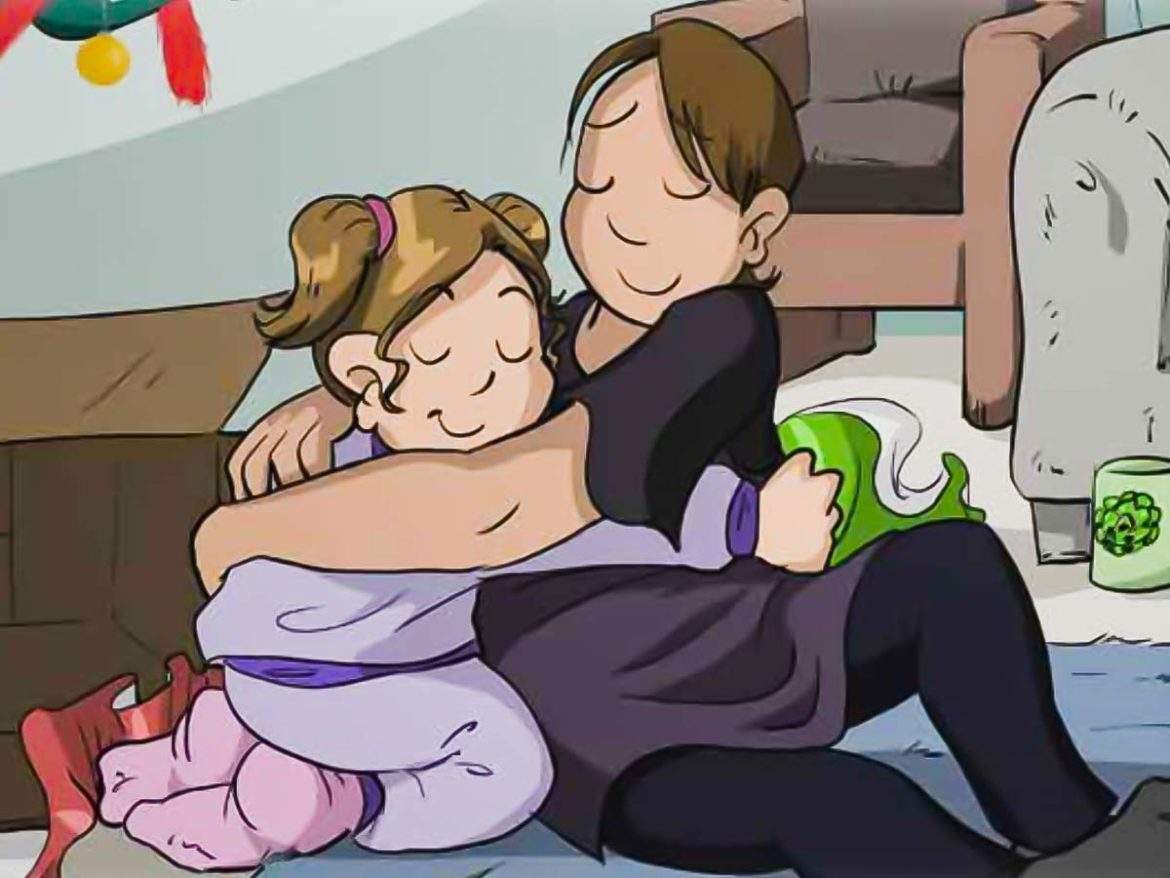
Sharing this post on social media? Use this description to make it accessible: [Image description: Illustration from ‘Rachel’s Christmas Boat,’ by Sophie Labelle. A young girl and her parent hug.]
Ugh, defensive, fragile, ignorant responses to reports of harm is why we can’t have nice things. Members of the Raising Luminaries community brought some recent events to my attention regarding Labelle’s portrayal of children in her material for adults. A quick breakdown on how we deal with things like this.
With Labelle’s most recent responses justifying her behavior, we can no longer recommend her children’s books. We don’t do ‘cancelling’ or punishment culture here, so here’s what a restorative process would look like if we’re to stay in community with Labelle. We suggest Labelle participates in a community accountability process to:
Gratitude and deep thanks to A.M. for first bringing this to our community’s attention.
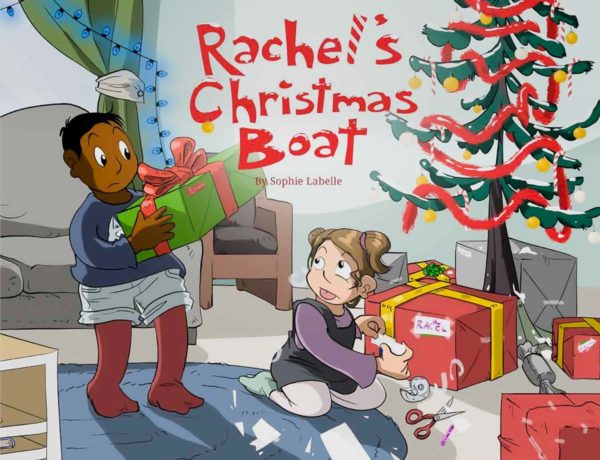
Rachel’s Christmas Boat
Keep Raising Luminaries & Books for Littles free and accessible for readers who can’t afford a paywall.
Posts may contain affiliate links, which allow me to earn a commission at no extra cost to you. Check out the full affiliate disclosure along with my statement of accountability. If you’re into supporting libraries (please do!) more than consumerism, you can also support my work directly:
Donate or shop using an affiliate link via| Paypal | Venmo | Ko-fi | Buy a t-shirt | Buy a book
A. Freak out and make it about all about Lulu?
B. Kick her dad out of the house and disown her despite the fact that Rachel is still the same exact loving parent she was before her transition?
or…
C. Accept Rachel with love and acceptance, because her dad is her dad is her dad – and Lulu loves her for who she is, not what gender she presents as?
[Answer: It’s C.]
Unlike most children’s stories about gender transition, Rachel’s transition is just a life event – similar to the ones many loving families across the world go through.
What I love most about this book is that Rachel’s transition isn’t the main focus of the story – the FOCUS of the story is how Lulu can support her dad (Rachel still keeps the title of ‘dad’) after realizing Rachel’s Christmas presents are covered with Rachel’s dead name.
Lulu’s effort shows kids that they can support and affirm family members and friends going through gender transition, reminding them that they are welcome and loved.
If my work makes it easier for you to raise kind & courageous kiddos, you can keep these resources free for everybody by sharing this post with your friends and reciprocate by supporting my work directly.
Ways to support Raising Luminaries: Paypal | Venmo | Ko-fi | Buy a t-shirt | Buy a book | Buy toothpaste | Subscribe to Little Feminist Book Club
But if your resources are limited – first support OUTright Youth of Catawba Valley – providing support & safe community for LGBTQ youth & allies in an anti-LGBTQiA2S+ community.
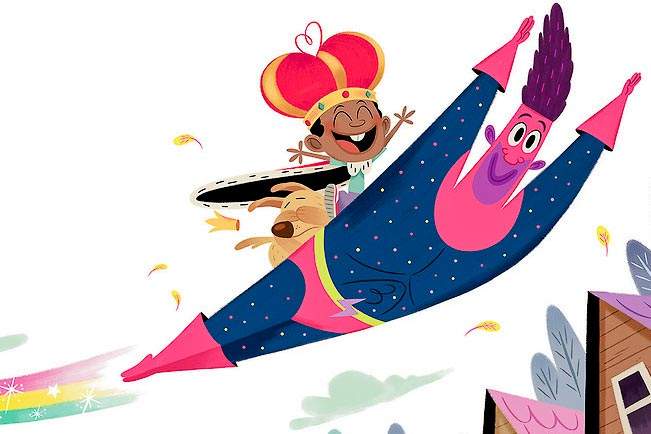
[Image Descriptions: Feature of an inner page of The King Of Too Many Things, by Laurel Snyder & Aurore Damant.]
Raising Luminaries is free and accessible for readers who can’t afford a paywall. Posts may contain affiliate links, which allow me to earn a commission at no extra cost to you. Check out the full affiliate disclosure along with my statement of accountability. If you’re into supporting libraries (please do!) more than consumerism, you can also support my work directly:
Reading books with my 3-year-old isn’t straight-forward, and it’s often frustrating. But it’s the best way I’ve found to connect with my kiddo to help them him through his obstacles. I’ve found it’s also a great way to foster a sense of empathy for others.
Since my kids read thousand of books each year, readers often ask which books we found the most helpful, engaging, and life-changing for early preschoolers. Here’s what we look for in a book for threes, along with the top ten books Q and R2 asked to read over and over again at this age.
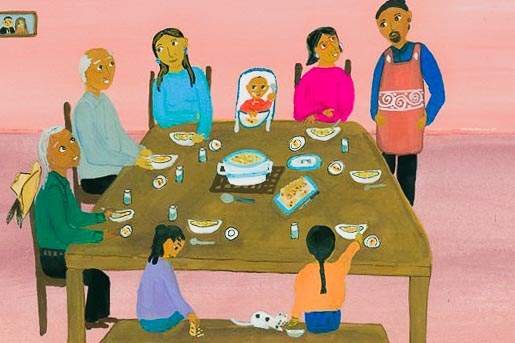
[Image description: Illustration from ‘We Are Grateful: Otsaliheliga’ by Traci Sorell & Frane Lessac, “depicting what looks like a family of eight people around a table for a meal, including two elderly people (grey/white hair, one of them balding on top), one baby in a high chair, two children on a bench, one of them feeding a cat between them. The people all have light brown skin, and other than the two elderly people, they all have black hair. They are wearing a variety of differently coloured clothes (blue, yellow, green, red, grey, orange), and the man standing next to the table is wearing an orange apron over his shirt and pants, with yellow swirls on it. On the back of the chair of one of the elderly people, there’s a hat with two feathers in it. There’s a framed picture on the wall in the background showing two people together.” / Gratitude to Charlotte Holzke for the lovely image description.]
In his post: Teach your kids the truth of Thanksgiving – modeling generosity and gratitude all year long – but don’t whitewash the violent history of colonization.
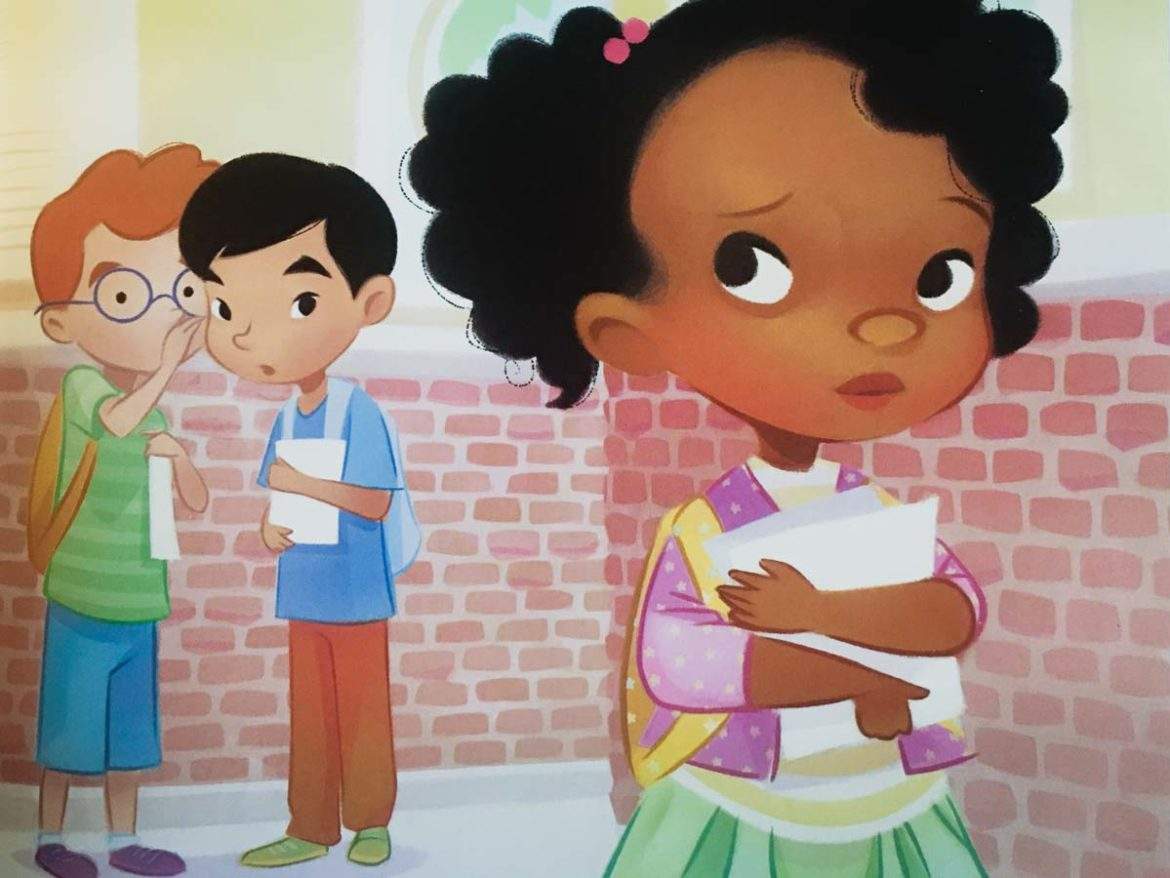
[Image description: Illustration from ‘Not Quite Snow White’ by Ashley Franklin and Ebony Glenn. A white child whispers into the ear of an East-Asian child as they look at Tameika, a Black girl. Tameika looks uncomfortable.]
In part 1 of this series on anti-racism for kids, we unpacked colorblind fallacies and discussed how refusing to acknowledge racial diversity further stigmatizes kids of color. With this collection, we teach kids why we must be mindful of social power in anti-racism work.
Bold and *marked titles are written or illustrated by #OwnVoices makers of color.
Raising Luminaries is free and accessible for readers who can’t afford a paywall. Posts may contain affiliate links, which allow me to earn a commission at no extra cost to you. Check out the full affiliate disclosure along with my statement of accountability. If you’re into supporting libraries (please do!) more than consumerism, you can also support my work directly:
Donate or shop using an affiliate link via| Paypal | Venmo | Ko-fi | Buy a t-shirt | Buy a book
Anti-Racism For Beginners 102: Understanding Social Power In Racial Discrimination
How to Use Kids Books To De-Center Whiteness
…
“My daughter is Asian American growing up in a super white city, and the microaggressions are beginning to wear on her” Anonymous reader from the Books For Littles Community
…
Racism, like all -isms, only exists within a hierarchy of social power.
We overlook how social power plays into systemic discrimination because when we have power, we breathe it like air. It’s completely invisible. Only the folks who don’t have the same power we do – those who struggle to breathe – can help us to recognize it by telling their stories.
Training our kids to see invisible power structures requires we recognize it in our daily lives.
Racism is not just discrimination between races. But that’s really hard to mentally grasp, so here, let’s try this…
(CONTENT WARNING FOR CHILD ABUSE)
If my five year old punches me in the stomach, I’m allowed to get upset.
Disrespectful! Unacceptable disobedience! How dare!
Even if I’m physically hurt, I’m still the one with control in this relationship. This flurry of tiny fists does not make me feel threatened or unsafe. I’m not afraid my 5-year-old will destroy my life. I’m not in any danger.
In our society, we adults have not just physical power over children – but also social power. All things being equal, a five-year old who shares the same privileges and social status as me can’t do me much harm.
Now reverse it. Let’s imagine I let loose and punch that kid 5-year-old right in their adorable little face.
Because of my size, I can physically overwhelm them and steal any sense of autonomous safety and control without their consent. (That loss of control – that’s the stuff complex trauma is made of, by the way.) Even when we equalize physical power in this situation, I’ve got more options. As teens, my kids will outweigh and overshadow me – but I still hold the authority.
But there’s also the impact of what happens when someone with power over you hurts you. I don’t just have personal authority over my kids. I have the privileges that come with adulthood. People trust my word over a child’s. I have connections, cash, and know how to work the system in a way a 5-year-old survivor of violence does not.
Long after their wounds have healed, this encounter will reverberate as an ongoing potential threat so long as I maintain power over them.
How we use intimidation to maintain power.
From the moment I hit my child – they will live with the understanding that I could use my larger physical mass, my social ties, and all the tools within my reach to hurt them. Whether they know it consciously or not, they must live with caution – knowing that I have the power to destroy them on a whim.
And yet – we don’t call an adult’s violence or disobedience toward a child ‘disrespectful.’ We call it discipline.
The punishments we meter to kids are manufactured consequences designed to maintain our societal norms. Adults controlling children through intimidation upholds our social structure. Which is why corporal punishment is still socially acceptable, particularly among families who believe there should be a social hierarchy.
Even though I don’t hit my kids, I am raising my kids in a culture of adult supremacy. I benefit from it at a cost to them – their freedom, and their sense of safety.
So when I raise my voice, and my kids flinch, telling them ‘I’m one of the good non-hitting parents’ dismisses a valid fear they have every right to feel. Telling them that they are ‘blowing things out of proportion‘ implies that I don’t recognize my power over them.
Refusing to acknowledge my power makes me even more dangerous because I’m oblivious to my power and how it impacts them.
Aaaand now that I’m writing this all out. I’m realizing I’ve never explicitly explained this to my kids. So I’m going to talk to them about it tonight.
See? We can all afford to do a little better. Like my light-skinned privilege, I didn’t create this power inequity and I don’t want it. But I still benefit from it and it’s my job to recognize when I’m doing it and empower my kids to protect themselves when I stumble into it.
I’m using this physical example of child abuse to illustrate a tool we use to dismiss and ignore oppressed groups – paternalism. Paternalism is the idea that those with less power (people who are oppressed) are incapable of identifying what harms them, and those in power (oppressors) know best for those they’re abusing.
Adults of color, disabled adults, and so on for all grown-ups who hold less social power – we are not children.
Paternalism also gives us a false belief that equivocating two different oppressed groups to gain a foothold for one of them, is okay. It’s not okay. It’s fundamentally problematic to do what I did above.
Go back and read it again, noticing the subtle way I normalized whiteness/adults as the default, equivocating people of color as children. As the author of this article, this is an abuse of my power and authority and feeds into the thing we’re claiming to fight.
See how that works?
Equivocating two marginalized groups to empower group A disempowers group B. This perpetuates a pattern of behavior that reinforces a supremacist mindset, and makes group A easier to pulled down in the long run.
(That’s why our fights for equality need to be intersectional!)
Equivalencies reinforce oppression for folks who hold both of those identities. Which we know from…them explaining it to us. But unfortunately, we often don’t listen to multiply-marginalized folks – because we see them as multiply-incompetent! This is one way we use our paternalistic view towards oppressed groups to defang and dismiss calls for equity.
As a small Autistic Asian feminine person, I’m perceived as less competent than my tall white male partner. When I tell people the things they do are problematic, or even that they are hurting me relating to my race, gender, or disability – I’m brushed aside. When my partner says the exact same things – people believe him.
My ‘stop‘ to a white man using yellow face is dismissed because I’m some hysterical nagging lady. My partner’s ‘stop‘ is a command , a truth, to be considered and believed.
The trouble is, as intelligent and kind as my partner is – my partner cannot ever fully feel the impact of these -isms. His accomplice work will always lack the nuance and details I can provide as a disabled person of color with lived experience.
When folks in power look for ways to fight racism – we tend to look towards authority (a position that has been traditionally entrenched with whiteness for hundreds of years) for advice.
So long as we center white voices in anti-racism work, we’re just perpetuating racism.
White supremacy culture views disobedience toward authority as a negative violation that threatens to unravel civilization. In our authoritarian society, it’s acceptable for folks with entrenched power to do unfair things to maintain power. We justify this because it keeps people who matter safe and comfortable. The question is – who matters?
The idea that some humans can and should have power over others to preserve their safety and comfort – that those with less power should obey and suffer, is integral to supremacy.
This is the corruption of power. This is the mandate of heaven. This is westward expansion. This is purity culture. This is the culture of conquest. This is respectability politics. But this is not a universal human belief. White supremacy is not human nature, it’s just the one we’ve grown accustomed to due to white supremacy and colonialism.
Disobedience can be healthy – even necessary for a healthy human society. Disobedience is a check on broken systems and wide social gaps in power. Obedience and disobedience must be practiced side-by-side for a healthy human community. That’s why disobedience is the antidote to corruption in so many stories of faith and justice.
What if disobedience was seen for what it is – a symptom of a system that is not working for everyone? If you value inclusion and believe powerful people are responsible for protecting the weak – maybe noodle on that.
Given that we’re unaware of our power and the ways others can perceive us as threatening – dealing with other humans can end up so terribly confusing. Because of this, we have to be mindful of it, and wield our power gently.
If we have no clue how systemic racism works within a social power structure, or even what racism is, we can’t teach our kids how to stop racist behavior.
If we’re unable to see the ways we are complicit in white supremacy (we all are – including me), we can’t teach our kids to dismantle systemic racism. Reverse-racism removes power from the equation of racism. This handy trick makes it easy to dismiss and silence people of color who speak up against racist action and systems of inequity.
It’s human nature for us to view those with less power as less capable. Which makes it easy to dismiss them. Which makes speaking truth to power very hard for folks with less power. Damn vicious cycle, is what it is!
This is what we call: Systemic racism. It’s a system, efficiently self-perpetuating. Gotta break it.
So how do we tell our kids of color that racial discrimination exists, and that it’s gonna be harder to do basic things like be humans in the world, simply because of our race? Without overwhelming them and sending them into a spiraling pile of tears and anxiety?
How do we teach white kids to shake off the instinct to dismiss people of color? Without provoking white fragility (more on that later) and inspiring them to justify negative treatment towards kids of color as inherently deserved?
How do we teach all our kids to disobey safely (and disobey we must!) when unjust systems are hurting people?
THE PLAN: Teach our kids to understand power inequity so they can name it, unpack it, and dismantle it when it happens in the real world. Let’s start these discussions with adorable picture books!
Teach our kids to be anti-racist as if lit from a fire below – bring power back to those who have had it denied. Social power is not a scarce or limited resource. We’re social animals who benefit when the community thrives – social power catches like fire. It grows. We lift up kids of color, and all kids rise.
Center. Voices. Of. Color.
The problem with books about racism written by white folks is that there are key elements about being targeted by racism that white folks just don’t know to include. It’s very hard for some of us with racial privilege to shut up and pass the mic. But we must!
We can tell kids of color that they can grow up to be President one day – but as an Asian girl raised on history books full of rich White men (and those few go-to Black men), I didn’t need anyone to tell me that no matter how I performed or organized my life, there is no way our country would be electing an Asian lady into the highest office of our government within my lifetime.
These books – all written by Black women, highlight how important it is that kids of color see themselves responsibly represented. Our kids can’t become if they don’t even see becoming as a possibility.
*Milo’s Museum, *Auntie Luce’s Talking Paintings, Schomburg: The Man Who Built A Library

Ages 4-8

Ages 6-12


Ages 9+ We originally included *Parker Looks Up in this list, but given the point of the book is respectful representation, after hearing from AICL on how this book stereotypes and denigrates Indigenous folks, that makes it an inappropriate pick to highlight responsible representation. Thanks Alyssa M. for catching that in the comments!
**Keepin’ it on the up & up: Zetta Elliott, the author of ‘Milo’s Museum,’ is one of the lovely supporters who keeps this post free and accessible for all – but I’ve been recommending her books since way before she joined our patreon community and have had plans to analyze how it differs from the tokenism in ‘Grandma in Blue with a Red Hat’ since way before we connected.
There aren’t many folks who break glass ceilings unscathed.
Our culture doesn’t do a great job at celebrating the battle scars of social progress. So we’ve got to teach our kids to value disobedience and a certain type of scratchy disagreeableness.
Who is seen as a ‘natural‘ – a natural talent, a natural leader, a natural beauty? Who is pinged for advancement and handed power because they ‘seem like a good fit‘ through some ambiguous gut intuition (aka unconscious bias)? We all love easy-going folks. It’s much easier to be easy-going if things are already going your way and society is not designed to progress at your expense. Nasty cycle.
By nature of this work – folks who smash glass ceilings must be disobedient and non-compliant. They lend themselves to being perceived by those who want to maintain inequity as unlikable or even dangerous. All those harsh b*tches, dragon ladies, angry Black women, [insert your least favorite slur here] – labels used to denigrate women of color who refused to accept their place as subservient.
So you’re going to have a hard time finding books about unlikable heroes. American children’s authors love sanding off the rough parts before going to print, as if kids can’t accept imperfect heroes. Sneaky paternalism.
For now though, you’ll have to settle for glass-chippers who manage to ignore haters. Normalize rebellion. Teach girls and nonbinary kids of color that disagreeableness isn’t to be feared – oppression is. Teach kids to value feminine disobedience, to disambiguate goodness from polite quietness.
Also – avoid saviorism. If you’re reading a book about racism and a white protagonist helps a kid of color through racial injustice, that’s not centering people of color, that’s disempowering POC as useless victims.
*Clara Lee And the Apple Pie Dream, *Not Quite Snow White, *Shining Star

Ages 7+

Ages 4-8

Ages 6-12


Being the only one person of color in a sea of whiteness is exhausting. Even though kids can feel it, they need our help naming it, analyzing it, and understanding the roots of it. If we don’t help them through it, kids grow up internalizing racism, believing that those microaggressions and the discomfort and trauma of being targeted by racist behavior is inherent to them, rather than a symptom of an unhealthy society.
By targeting cultural associations instead of skin color, aggressors excuse racist behavior as not-racist because it’s about something like a name, a hijab, or targeting someone within their own racial group. This bigotry centers whiteness as the default, and anything deviant from whiteness as inferior.
Notice that the kids in these stories aren’t explicit targeted because of their race, but the aggression against them is still racist. Kids need to see that oppression expands beyond simply skin color or racial identity. We target Muslims because Islam is perceived as a threat to Eurocentric Christianity (it’s not.) We target Asian names because they don’t conform to Whiteness. We target darker-skinned people even within the same family or race because of colorism – tool to divide and conquer within each group of color that elevates proximity to whiteness.
Within each book – we see how external aggression from outsiders become internal thoughts that drive each child’s behavior. Individual acts of racial bias are just the tip of the glacier in white supremacy. Racism is a system that teaches kids of color to value whiteness. Racism exhausts a child of color’s ability to thrive because their minds and bodies are too busy orienting themselves around whiteness in order to stay safe in a racist society.
*The Proudest Blue, *Always Anjali, *Sulwe, *Where Are You From?

Ages 4-8

Ages 4-9


Keepin it on the up & up: Sailaja Joshi, the founder of Bharat Babies & publisher of Always Anjali, is one of the delightful patreon supporters who keeps my work open and accessible for all – but I’ve recommended Always Anjali before we connected.
Join us to support these articles and help ignite a generation of kind & brilliant luminaries.
Support these resources via Paypal | Venmo | Ko-fi | Buy a t-shirt | Buy a book
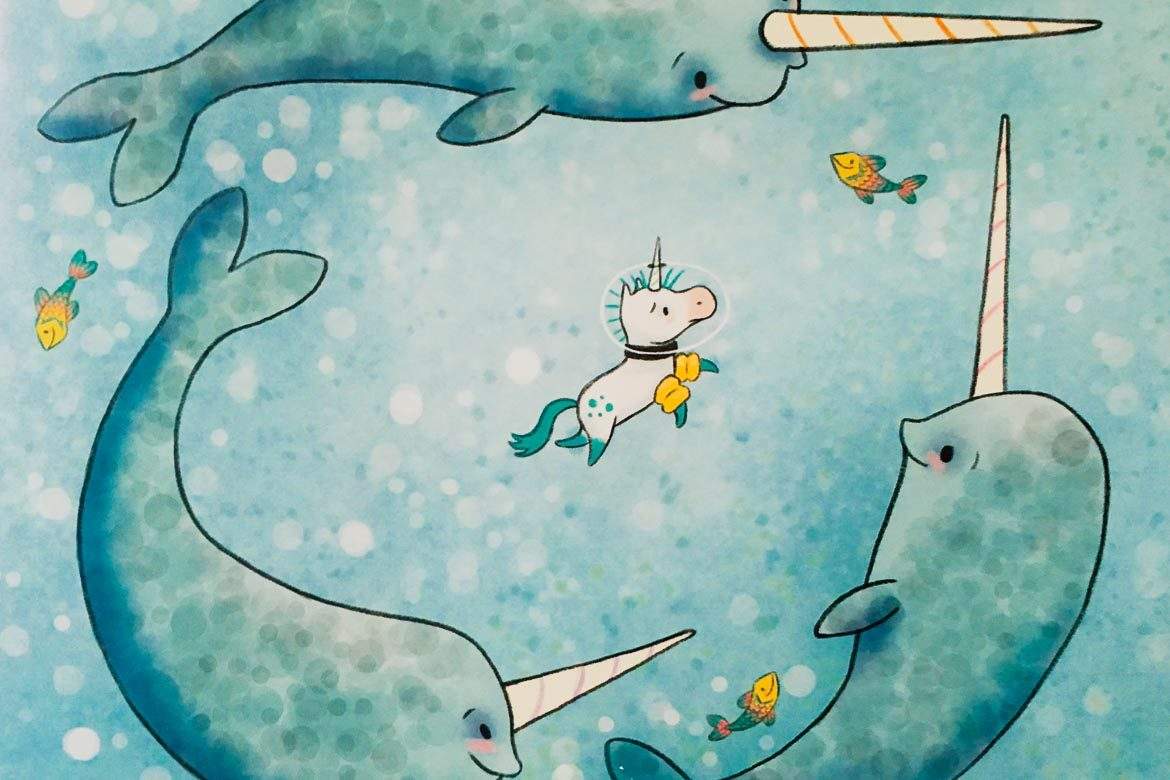
[Image Description: Interior image from ‘Not Quite Narwhal‘ by Jessie Sima, featuring a small unicorn underwater, wearing an underwater breathing helmet and arm swimmies. His eyebrows are furrowed in concern. Three large, smiling Narwhals and three smiling colorful fish encircle him.]
Raising Luminaries is free and accessible for readers who can’t afford a paywall. Posts may contain affiliate links, which allow me to earn a commission at no extra cost to you. Check out the full affiliate disclosure along with my statement of accountability. If you’re into supporting libraries (please do!) more than consumerism, you can also support my work directly:
Donate or shop using an affiliate link via| Paypal | Venmo | Ko-fi | Buy a t-shirt | Buy a book
They’re going to get picked on. They won’t fit in.
Captioned age ranges are for when my sons were able to understand and enjoy each story. The rest of the images in this post are book covers of titles referenced alongside the images.
Reminding kids that ‘fitting in’ isn’t the goal – we all have our own strengths and weaknesses. We don’t have to all match and do things the same way. We don’t have to contort ourselves into traditional roles. Being ourselves, being different – it’s not worse, it’s just different.
The following book images include: Finklehopper Frog, Rosie The Raven, Red: A Crayon’s Story

ages 3+

Ages 2.5+

ages 2+


It’s dangerous to stick out in a community – humans are social animals, and we’re not particularly kind to outsiders. These stories validate anxious feelings about being different and show kids that contorting ourselves to fit in can cause more trouble than it’s worth. It’s healthier to accept ourselves the way we are and focus on more important things.
The following book images include: A Bad Case Of Stripes, Zero, A Tiger Tail

Ages 3+

Ages 4+

ages 4+


When we’re the first to break out of the pack, we’re going to get questioned, picked on, and bullied. We can make it easier on our kids by explaining why difference makes humans feel uncomfortable, showing them that people like them have done this before, and arming them with what they need to resolve conflicts and stay brave.
Even though he wear dresses when we first read these stories, Morris Micklewhite And The Tangerine Dress and Jacob’s New Dress showed my son that gender roles are arbitrary nonsense.
When he found an awesome Batman dress at the store, we were able to discuss the risks and negative comments he’d get at school. He could make an educated decision.
Armed with this knowledge, he insisted he should get this dress because, “If I wear a dress to school, then the other boys who want to wear dresses will know it’s okay.” (This dude knows how to push my proud-mom buttons.)
More books on non-conforming gender roles: From The Stars In The Sky To The Fish In The Sea (non-binary character) Small Saul, and How To Be A Lion.

Ages 3+

Ages 3.5+

Ages 3.5+


Ages 4.5+

Ages 3.5+
Bullies happen. It doens’t matter what’s it is, whether being different is a choice or our immutable identity, insecure jerkwads are going to pick on us. By showing our kids confident stories of people who manage to get through bullying with confidence, they can feel less alone.
Spaghetti In A Hot Dog Bun raises issues of self-doubt, and then ultimately self-acceptance when faced with a bully.
Molly Lou Melon gives no shits about what her bully thinks of her. She’s too busy being a boss.
Amelia Bedelia (who clearly codes as autistic) is constantly picked on in the early books for misunderstanding figurative language. Doesn’t matter, because she’s freaking amazing at baking, and fine with who she is.

Ages 4.5+

Ages 3.5+

Ages 4.5+


We usually don’t realize that we’re hating on our own kids, but it turns out that the people who can be most critical and the least accepting of our differences are the people who love us the most. This is a thing, particularly for children of color with unintentionally white supremacist parents, disabled kids with ignorantly ableist parents, and of course LGBTQ+ kids living in transphobic and homophobic families.
Not all of these stories end in acceptance, but that’s reality. The point of these books is to validate that frustration of being shamed and ridiculed for being different. They show kids that they’re not alone.

Ages 3.5+

Ages 4.5+

Ages 3.5+


Ages 6+

Ages 4+


We all learn, at some point, that those who reject us aren’t very much fun to hang out with anyway. We can try to contort ourselves to fit in – but it’s going to make us miserable. If we spend our energy trying to pass as normal, we’ll have no energy left to find what makes us awesome.
The only way to find a community that accepts us is to just let our weird out. The louder we get, the more likely our people will find a safe place alongside us.
You kind of owe it to them, actually. Get loud! Your people are searching for you!
The following book images include: The Red Lemon, Where Oliver Fits, Strictly No Elephants

Ages 1.5+

Ages 4.5+

Ages 3.5+


Real Friends, Not Quite Narwhal, Perfectly Norman

Ages 8+

Ages 4+

Ages 4+


Weirdos have been reviled, detested, and shamed since forever. Read stories of real people who were rejected, over and over, only to rise above and open new possibilities for humanity.
Oh – and don’t think I’m not noticing how white this list is. I’m still searching for books on oddballs of color, but for now, it makes sense that being ‘weird’ and still allowed to function in society is a privilege afforded exclusively to white folks. Let’s change that by fighting for inclusive classrooms, supporting affirmative action, and taking a good hard look at how we view and punish ‘problem’ behavior in kids of color.
The following book images include: The Boy Who Loved Math, The Girl Who Thought In Pictures, Miss Mary Reporting, Nadia: The Girl Who Couldn’t Sit Still

Ages 5+

Ages 4+

Ages 5+

Ages 5.5+


We can’t be what we can’t see. If we want to teach our kids to be unapologetically themselves, that they have value and are worthy of respect, safety, and confidence exactly as they are – they need to see more shameless weirdos.
The following girls follow their special interests no matter now many snide comments they get. We’ve had books about boys going on big adventures and pursing their dreams for decades, so today we’re focusing on the ladies.
The following book images include: Red Is Best, Starring Carmen, Sophie’s Squash

Ages 1-4

Ages 3+

Ages 3.5+


The following book images include: Mary Had A Little Lamp, Marisol McDonald Doesn’t Match, Rosie Revere, Engineer

Ages 1.5+

Ages 4+

Ages 3.5+


The following book images include: Imogene’s Last Stand, Hana Hashimoto, Sixth Violin

Ages 4.5+

Ages 5+


Whether you’re lining up train cars, designing a cure for cancer, or building mud pies, the world needs the innovative ideas that come from out-of-the-box thinkers and doers. No matter how big or small (or non-existent) our impact, the world needs us to do what we do.
We can make a difference, but we won’t know until we’ve tried (for years. And years. Maybe even not in our lifetime.)
The following book images include: The Library, Tough Chicks, Not Your Typical Dragon

Ages 4+

Ages 3+

Ages 3+


The following book images include: Calvin Can’t Fly, Tacky The Penguin, Cloud Country

Ages 4+

Ages 3.5+

Ages 4+


Ages 3+

This bears repeating – our kids have value and are worthy of respect, safety, and confidence exactly as they are.
We can be extraordinary, ordinary, or just kinda hanging out and picking our noses all day. We still belong here. We are still worthy, still a part of humanity. No matter what we look like. No matter what we do. Unconditionally.
The following book images include: Incredible Me!, Lovely, Extraordinary Jane

Ages 4+

Ages 1+

Ages 3+


When classrooms and playgrounds are fraught with uncertainty and confusion – make story time a sanctuary.
It’s okay to go slow. These books are tools to be used slowly. Read one book each month, and give them time to absorb, reflect, and talk about feelings of identity and self-acceptance.
What will you tonight, now that you know these principles of self-acceptance and now have the tools to change the world?
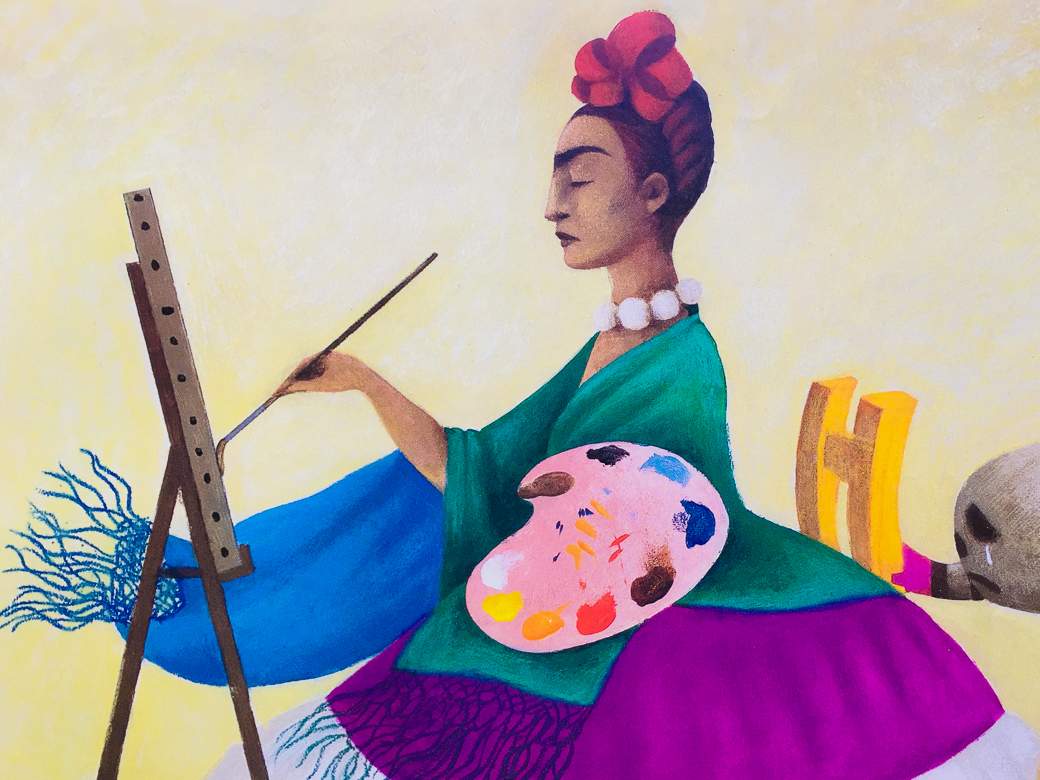
[Image Description: Interior illustration from Frida, by Jonah Winter & Ana Juan, featuring Frida Khalo in profile, painting her pain onto an easel.]
This is the fourth of a four-part series: In this post, you’ll find stories featuring disabled heroes throughout history, learn about the fight for disability rights, and discover how to recognize ableism in biographies written for children.
Raising Luminaries is free and accessible for readers who can’t afford a paywall. Posts may contain affiliate links, which allow me to earn a commission at no extra cost to you. Check out the full affiliate disclosure along with my statement of accountability.
Disabled people have fought for recognition and human rights throughout the history of humanity. We teach our kids about self-advocates, heroes, and the contributions of disabled bodies and minds so they understand the value of an inclusive society that values all voices.
Fight the dominant narrative in that tells us disability renders us incompetent and irrelevant. The stories below fight the erasure of disabled history – and shows us how far we have left to go.
These books are not perfect, and they should not be read word-for-word. The following books are rife with historical error and hyperbole, sanitized and white-washed. Reading and discussing them requires you work.
Until makers create engaging stories that expose inequity, it’s on us grown-ups reading aloud to recognize the ableism inherent in these stories and call it to the surface so our kids learn to identify it, critique it, and fight against it.
These stories inspire my kids to keep learning – to dig deeper and ask questions, to talk about role models with friends, and find solace and courage in the people who cleared a path for them to follow.
BALANCE PLEASE! Avoid feeding into the idea that only disabled savants have value as humans. Sprinkle in books about disabled savants, like the ones below, with even more books normalizing average folks with disabilities. While people with disabilities are powerful and deserving of our admiration, disabled people who don’t have savant skills also have a right to agency and human rights.
We don’t need to make up for our disabilities by being helpful to abled folks – every human has a right to exist on this planet regardless of our contributions to humanity.
Captioned age ranges are for when my sons got ‘the gist’ of the story with discussion & alternative readings – most contain text for much older ages.
 An Apple For Harriet Tubman: Abolitionist & US Spy (Epilepsy/Narcolepsy – unclear).We’ve read like 20 picture books on Tubman, and no author is willing to portray this powerful hero in US history as disabled – but she was. This story comes closest to addressing her disability, but never quite gets there. Either way, our kids should be aware that one of the fore-mothers of equality and civil rights was disabled – and she was competent and capable.
 ‘Amy, The Story Of a Deaf Child‘ – Amy Rowley: Education Rights Activist (Deaf)
Ages 4+

Ages 4+

Ages 3+

Ages 3.5+

Ages 4+

Ages 6+

Ages 5+

Ages 6+

Ages 10+

Ages 5+


 ‘This Kid Can Fly’ – Aaron Philip, Illustrator (Cerebral Palsy). This chapter book is a bit above our Little’s heads, but I enjoyed it and it gives us some insight into the intersection of how race, wealth, and citizenship status affects disabled kids and teens.
Ages 4.5+

Ages 4.5+

Ages 4+

Ages 7+(?)

Ages 4.5+

Ages 8+

Ages 6.5+

Ages 5+

Ages 5+

 ‘The William Hoy Story – William Hoy, Baseball Player (Deaf)This story showed us how players with disabilities can inspire league-wide disability accommodations that help every player.
Ages 4+

Ages 4+


 ‘Odd Boy Out‘ – Albert Einsten, Mathematician (Learning & communication disabilities, unspecified). Also check out: I Am Albert Einstein.
Ages 4.5+
Ages 5+

Ages 4.5+

Ages 4.5+

Ages 5+

Ages 4+

 Ray Charles – Ray Charles, Musician (Blind). This is gorgeously written, but completely over my 5 year-old’s head.
 Knockin’ On Wood – Peg Leg Bates: Dancer (Prosthetic leg)
Ages 6+

Ages 7+

Ages 5.5+

Ages 5+
This page is no longer updated with new books.
Not to worry – click here to find our latest additions to our collection of Disability History Books for Kids.
This is going to be difficult. It’s a review of a book I received to celebrate Multicultural Children’s Book Day. It didn’t turn out as planned. After the review, you’ll find a list of really awesome books that celebrate cultural diversity. As a rule, I’m against reviewing well-intentioned books bother me, but I agreed to do this review before I realized what I was getting into. If you’d like to skip past any uncomfortable points, then go ahead and skip to the giant list of books at the bottom of the page.
Read the below with this in mind: All artists, doers, makers, and world-changers start somewhere. Everything we do is an experiment, and nothing we make will please everyone. I’m writing this review because I know the intent is good, and the people who made this book will have a bright future with powerful, awesome, world-changing books that meet the high bar we need to set for multicultural literature moving for
ward. So no matter what – keep making books, keep making art, keep going.
Publisher: Inner-Flower Child Books
For ages (not recommended)
A member of the Books For Littles Facebook group posted about Multicultural Children’s Book Day. The mission is to give visibility to books featuring diverse characters, educating kids about people who live differently than they do, and celebrating difference. I loved the concept, and it fits the Books For Littles mission perfectly – promoting stellar books that celebrate diversity, cultural awareness, and compassion for little kids. Bingo. I’m in.
The book we received, ‘Sun Kisses & Moon Hugs’ fills a need that (white, suburban) families have, and the authors should be proud of the many 5-star Amazon reviews, because all art has a place with the right audience. If you want a book on your shelf that has a few non-white characters but doesn’t get into sticky territory such as teaching your kids about alternative cultures, non-stereotypical racial diversity, or dimensional characters non-white or minority characters, then this is for you.
If it this was sent to me in support of a mindful-hippy-love book, I’d be like, “Yes, 5-stars for flowery hippy stuff!” But it wasn’t. We’re not into that sort of thing over at Bumblebee Hollow, but this might do well in a house full of Birkenstocks and incense. I’d be able to objectively say that it succeeds in making someone somewhere happy. Good for them. Not for us.
If this book was sent to me under no particular theme, I’d give it 3-stars as for tackling separation anxiety in a unique way. Again, not our thing, but if you’re into astral projection and homeopathic sunshine, go buy it. It was done better in Elin Kelsey’s ‘You Are Stardust‘ which uses science-based facts, comforting philosophical logic, and innovative graphics to get the same message across. A few other spectacular separation/death anxiety books include ‘The Invisible String,’ ‘The Kissing Hand,’ and ‘Max at Night.’
There’s no story, which I’m not going to dock points for, but I think this book was meant to be a poem.
“The sun will catch your kiss and use light speed, to forward it right on to me. I’ll send a million kisses back your way. You’ll feel my love in each warm ray.”
That’s a rhyme, I think.
I still can’t get a hold on a cadence, but every page has a couple of lines that kinda sorta rhyme. This drives me insane. If you want to read books with amazing, thoughtful, witty poetry, I’d recommend Kevin Lewis’s ‘Runaway Pumpkin,’ ‘Chugga Chugga Choo Choo,’ or ‘Not Inside This House.’ Also amazing: Margaret Mahy’s ‘Bubble Trouble‘ and for older kids, Julie Fogliano’s ‘When Green Become Tomatoes.’ Or, of course, anything by Dr. Seuss. These authors all toiled to create perfect prose so these stories would be dramatic and fun to read out loud.
If your child is autistic, hasn’t reached the age of reason (roughly age 7), or has another developmental delay that keeps them from processing figurative language, I would steer far clear of this book unless you want to add in a disclaimer after every line. I’m not interested that sort of work unless there’s something else going for the book.
Since I abide by strict rule not to lie to my kids, and to teach accurate science and facts, I was uncomfortable reading figurative language about the natural world that amounted to pure nonsense (and not the fun kind of whimsical nonsense). My kisses do not slide down rainbows, nor can they break earth’s gravity to bounce off the sun using light speed (how in the cosmos does one ‘use light speed?’)
As I read each page out loud, my eldest got more and more confused. For preschoolers, the difference between lying and using metaphor is a blurry, confusing boundary. Sure, it’s an exercise in non-literal language, but that lesson is hard to teach while reading a narrative in the first person.
“From wherever we stand, you see the moon and I see the moon. That is how we can send each other hugs.”
No. Not true on many different levels of space, time, and physics. I can’t tell him that. That is an actual, literal, lie. How can he trust anything I say after spouting that nonsense?
If I tell him teacups are hats and I like to eat houses – he gets that, that’s a joke. It’s not quasi-scientific and he’s got a firm enough grasp of social norms, hyperbole, and physics – he knows I’m exaggerating. Grasping that kisses are not photons and that you can’t see the moon at the same time if you’re on opposite ends of the earth – nope. That’s going to set them up for a whole lot of confusion down the line.
If your kid can grasp this level of metaphor, go ahead and read it, but if there is anything near the slightest possibility that your kid might be on the spectrum or this might compromise his fundamental understanding of space, time and physics, read this with great caution and many caveats and disclaimers.
Both boys (ages 2.5 & 4.5) were silent during the read. Through all but the worst books, we have discussions about empathy, personal experience, what we learned, and the excitement of the story after each page. This particular book didn’t go over so well. At best, I’d say they were underwhelmed and confused. When I asked my 4-year-old for a testimonial, hoping for something I could write about in the review, I got this:
“It’s pretty good? I don’t like it. But, sure, it’s okay. Can we bring it back to the library now?”
As for me? Uh. Erhm. Well, honestly?
I am furious. I’ve read it over and over this last week, looking for a good spin. I can’t spin it. This is a spectacularly low bar for diversity education.
This was the book someone chose to send to me with the specific guideline of celebrating diverse cultures. I am, to put it lightly, dismayed by this decision. This sets a very, very low bar for American children’s literature.
Teaching children about diversity in culture could go many ways. We could investigate and learn about a single culture that is different from our own. We could learn the history and reasons behind our own cultural traditions. We could view a wide array of diverse cultures and the similarities and differences. If the point is to learn about culture, there are many ways to do it.
What we cannot do, ever, is consider an education on diversity to be satisfied by simply painting faces a few shades darker brown.
We cannot include stereotypes of Cartman-esque brownish children on a vague frozen tundra. I can’t even figure out if we’re stereotyping indigenous North Americans or Northern Asians. Doesn’t matter, their sole point in the book is to convey the concept of far-away & otherness.
We cannot include the single dark-skinned boy featured in front of an urban landscape and the white kids in suburbia. We can’t focus primarily on white kids doing regular American things, and throw in an Eiffel tower with another white girl to signify globalism. We can, like this book did, leave out the entire continents of Asia and Africa while kinda sorta making an attempt at global connection using only northern continents. Everyone does it. I’m used to it. I don’t even have the energy to advocate for myself as an Asian, so I’ll stick with the cultures that are currently being maligned, mistreated, murdered and deported right from our country right now.
This book went neither wide nor deep. Frankly I’m just confused. In what universe is this a celebration of any culture other than North American suburbia (and maybe Paris)?
This is the definition of tokenism. This is exactly what people of color mean when we complain about being used as accessories. This is pandering to the concept of diversity without actually celebrating and valuing another culture. The message in this book is clearly “We are white, and this is our story. Also brownish people exist somewhere.”
Let’s be clear – the creators did nothing actively wrong. From what I’ve seen, they are well-intentioned mothers living in a very fun-looking lifestyle. The accompanying website is adorable and they seem like very nice ladies. The author, Susan Bernardo has collaborated on books with LeVar Burton. Everyone loves LeVar Burton! I’m told she’s ‘a big advocate for kids’ reading,’ which is a fun thing to advocate for because no one is against it.
But come on, guys. We can’t add a little brown to a few characters’ skin tones, wipe our hands together in satisfaction and consider this our contribution to equality. As authors, publishers, organizers and reviewers, we have the power, influence, and obligation to add characters with rich environmental backgrounds and heritages, abilities, body sizes, genders, and experiences. We don’t have room for this level of education and we have to bring more to the table in every. single. thing. Especially children’s books, the thing we use to educate our kids amidst work deadlines, packing lunches and busy schedules.
Hold on I have to take a deep breath and walk around for a bit.
For many authors with the privilege of time, money, and resources to publish a story, diversity in race and culture is an optional flourish. Adding non-whites is a token gesture that takes no additional effort, but gets families like mine to quit raising hell about the lack of white characters. It’s like a gift, except the gift is the most basic, stereotypical representation that does absolutely nothing for our actual equality. Simply making a few characters a shade of brown and adding a tiny kid in a wheelchair in the scenery gets your book access into a multicultural children’s bookshelf. That’s the bar we’ve set for ourselves.
I am…angry about this.
Raising our kids to celebrate diversity and understand that ours is not the primary and most important culture in the universe is not going to happen without some serious research, reflection, and hard work. If we’re going to combat racism, social injustice, and cultural divides, we need to read powerful books with our very limited time. Children’s books must take an active role in celebrating people of color and non-suburban white cultures rather than using them as accessories.
We need an equal ratio of males to females in EVERY SINGLE BOOK. We need dimensional, positive, and equal representation for multiple races in EVERY SINGLE BOOK. This isn’t a multi-cultural book. It’s just a book. This should be the bare minimum, not a book we have to actively market as an exception to the majority of books featuring white boys with trucks and white girls in tutus.
The publisher could have filled with this space with powerful literature from authors who have hustled hard to educate our children on diversity and cultural awareness. Modern families don’t have the time or energy to sift through clutter to get to the good stuff, so we have to guard our resources carefully – including the innocuous, tiny decisions that we make in choosing our story-time books. Because of this fact, I can’t endorse this book as a multi-cultural book, and consider it rather harmful.
I want to be sweet and grateful for this free book, and laud the authors with applause and support, but guys – our fellow citizens of color are in danger, our fellow Americans are dying on the streets, there are child refugees being denied asylum because of religion, and this filler is getting in the way and stealing our attention.
Ugh. Guys. I really don’t want to skewer the work of people who just wanted to make something nice to share with other families. But we can do better than this. We HAVE TO.

#ReadYourWorld
(Graham)
We follow the sun personified as it travel around the world in Bob Graham’s powerfully simple, peaceful writing style and illustrations that depict diversity across many of his books.
“The sun took off over the countryside, woke bears and snow cats, and caught Kosha and his father on their way to market.”
That prose tho. Damn.
(Hesse & Watson)
While this family could live in any northern European or North American country during a depression or time of war, this book shows us the challenges and experiences of a family living through a time of famine and poverty. Three kids are hungry and their single mom can’t make enough to feed them. This story shows the challenge of integrity versus hunger and eventually, compassion. It’s a bit washed, as a story goes compared to the reality of living in poverty, but a good intro to educate kids about families, societies, and times when those in need don’t have enough to survive.
(Bateman)
This is mostly a fairy-tale but takes place in Ireland during the potato famine. It gave us a chance to discuss why my children’s ancestors emigrated from Ireland in the 1800’s and some of the cultural pride we’ve kept as Irish Americans.
(Rockliff & Brooker)
An apartment building full of people of different ethnicities and cultural traditions gather together every week for a Shabbat dinner hosted by a kind and welcoming neighbor. This gathering of traditions and kindness is a super-sweet book recommended by a member of BFL facebook group. (Hi, Omer!)
Another great Shabbat book, read ‘Bim and Bom: A Shabbat Tale‘ by Daniel Schwartz & Melissa Iwai, featuring a female carpenter and male baker sibling duo (ALL THE FEMINIST POINTS!) and the joy of preparing for family time together on Shabbat.
(Meltzer)
From the Ordinary People Change The World series, this was our introduction to physical disability beyond wheelchairs and Helen Keller’s ability to use her disabilities for positive change (as a strength rather than a weakness) is empowering for those of us in other disability communities and cultures.
‘The Sound of Colors‘ by Jimmy Liao is also a nice read – unhindered by sight, a girl images what is around her using her imagination in surreal illustrations.
(Yaccarino)
(Choi)
Unhei, a Korean immigrant starting school in North America hits bumps while navigating her new home and retaining the comforts of her old one. She’s anxious to fit in and has to decide what she’s going to keep from her old culture, and what she has to let go of.
(Newman & Thompson)
This basic toddler board book shows a two-mom family constellation in all of it’s normalcy.
(Averbeck)
A traditional folk tale in modern Cameroon, this book features rich illustrations, a moral on hard work, boasting, humility and cleverness – and a recipe for bitterleaf stew.
(Brown)
Lisa Brown has a plethora of great books and this is one of our favorites. It features an exceptionally diverse cast with mixed-race families, people with turbans, burkas, a cell-phone-obsessed woman in a pantsuit, and various ages and abilities. The best part of the book is the rich background detail. Once you’ve gone through the book reading about the main family, you can then go back and re-read it paying more attention to each of the several background characters to watch how each story unfolds – many of which are extremely touching and sweet.
(Alexie & Morales)
I’ll admit, I got this book because I was hoping it was about farts.It was soooo much better though. Thunder Boy’s frustration hit home with me and would have been so validating to read as a little kid, while I was wrestling with a weird name of my own and all the school-yard taunting that comes with it.This book is a succinct, gorgeous introduction to a traditional Native American naming tradition and it goes from validating to powerful by the end of the book. Highly recommended if you gave your kid a weird name, or even if you just love a charming, fun read.
(Penn & Gibson)
Check our more Books For Littles posts before your next library trip.
1 Multicultural Children’s Book Day 2017 (1/27/17) is its fourth year and was founded by Valarie Budayr from Jump Into A Book and Mia Wenjen from PragmaticMom. Our mission is to raise awareness on the ongoing need to include kid’s books that celebrate diversity in home and school bookshelves while also working diligently to get more of these types of books into the hands of young readers, parents and educators. Despite census data that shows 37% of the US population consists of people of color, only 10% of children’s books published have diversity content. Using the Multicultural Children’s Book Day holiday, the MCBD Team are on a mission to change all of that. Current Sponsors: MCBD 2017 is honored to have some amazing Sponsors on board. Platinum Sponsors include Scholastic, Barefoot Books and Broccoli. Other Medallion Level Sponsors include heavy-hitters like Author Carole P. Roman, Audrey Press, Candlewick Press, Fathers Incorporated, KidLitTV, Capstone Young Readers, ChildsPlayUsa, Author Gayle Swift, Wisdom Tales Press, Lee& Low Books, The Pack-n-Go Girls, Live Oak Media, Author Charlotte Riggle, Chronicle Books and Pomelo Books. Author Sponsor include: Karen Leggett Abouraya, Veronica Appleton, Susan Bernardo, Kathleen Burkinshaw, Maria Dismondy, D.G. Driver, Geoff Griffin, Savannah Hendricks, Stephen Hodges, Carmen Bernier-Grand,Vahid Imani, Gwen Jackson, Hena, Kahn, David Kelly, Mariana Llanos, Natasha Moulton-Levy, Teddy O’Malley, Stacy McAnulty, Cerece Murphy, Miranda Paul, Annette Pimentel, Greg Ransom, Sandra Richards, Elsa Takaoka, Graciela Tiscareño-Sato, Sarah Stevenson, Monica Mathis-Stowe SmartChoiceNation, Andrea Y. Wang
We’d like to also give a shout-out to MCBD’s impressive CoHost Team who not only hosts the book review link-up on celebration day, but who also work tirelessly to spread the word of this event. View our CoHosts HERE.
MCBD site: http://multiculturalchildrensbookday.com/
Free Multicultural Books for Teachers: http://bit.ly/1kGZrta
Free Kindness Classroom Kit for Homeschoolers, Organizations, Librarians and Educators: http://multiculturalchildrensbookday.com/teachers-classroom-kindness-kit/
Free Diversity Book Lists and Activities for Teachers and Parents: http://bit.ly/1sZ5s8i
#ReadYourWorld